May-June 1941: Brevity and Battleaxe
Bibliography with Notes plus Bonus Content
Bickers, Richard Townshend. The Desert Air War: a gripping historical account of the RAF’s role in North Africa during World War II. UK: Lume Books, 2018. Kindle.
Chapter Four
“…Between 28 and 30 May, 14,500 men out of the remnants of the defeated British and Commonwealth land, air and sea forces were shipped back to Egypt, along with 2,000 Greek troops. Thousands of Allied troops had been killed and wounded and 13,000 Allied prisoners taken.”
Bierman, John and Colin Smith. War Without Hate. New York: The Penguin Group, 2002, p. 86.
“…Wavell made two attempts to dislodge the Germans from their positions along the Libyan-Egyptian frontier. Operation ‘Brevity’ in May 1941, and Operation ‘Battleaxe’ in mid-June were costly failures.
“…Churchill sacked Wavell…Wavell’s replacement was General Sir Claude Auchinleck…”
Braddock, David. Britain’s Desert War in Egypt and Libya, 1940-1942: ’The End of the Beginning’. Yorkshire: Pen & Sword Books, 2019. Kindle.
Chapter 6 The Second British Offensive. Operation “Battleaxe”
“…but the British cruisers, Crusaders and Valentines soon acquired a reputation for mechanical unreliability as well as sharing the chronic British weakness in armament.
“In consequence a weapon gap arose which was not closed in the desert until the Grants and Shermans with their 75 mm guns appeared in 1942.”
Cooper, Artemis. Cairo in the War 1939-1945. London: John Murray (Publishers), 2013. Kindle.
Chapter: Administrative Problems
“In June 1941, GHQ was still recovering from the three defeats of Cyrenaica, Greece and Crete.”
Cooper, Artemis. Cairo in the War 1939-1945. London: John Murray (Publishers), 2013. Kindle.
Chapter: Disaster in All Directions
“The Army, however, had no inkling of Rommel’s 88mm guns which were about to be used in an anti-tank role for the first time in the desert.
“They were horribly accurate. Tank after tank burst into flames…”
Roba, Jean-Louis. Luftwaffe in Africa, 1941-1943
(Casemate/Illustrated). Havertown, PA: Casemate Publishers, 2019. Kindle.
2. British Counterattacks Fail
“On June 22, 1941, Barbarossa, the invasion of Soviet Russia, was launched. This vast operation naturally impacted German activity in the Mediterranean sector.”
Shores, Christopher F., and Giovanni Massimello with Russel Guest. A History of the Mediterranean Air War, 1940-1945: Volume One: North Africa. London: Grub Street, 2012. Kindle.
CHAPTER 6 REVERSES AND REINFORCEMENTS
“Both sides now paused to regroup and build up supplies with the result that little occurred in the air for the next few days…
“The campaign in Greece was also at a close at this time, and by 30 April the British Commonwealth forces there had been evacuated…”
Shores, Christopher F., and Giovanni Massimello with Russel Guest. A History of the Mediterranean Air War, 1940-1945: Volume One: North Africa. London: Grub Street, 2012. Kindle.
CHAPTER 9 OPERATION BATTLEAXE
“In the desert the Axis forces had now also halted, making no attempt to press their advantage and advance further into Egypt. Claims were made at the time that the air resistance offered had brought them to a halt, but in practice Rommel had received firm orders to proceed no further at this stage…since within a few days the massive German attack on the Soviet Union would commence.”
Shores, Christopher F., and Giovanni Massimello with Russel Guest. A History of the Mediterranean Air War, 1940-1945: Volume One: North Africa. London: Grub Street, 2012. Kindle.
CHAPTER 9 OPERATION BATTLEAXE
“The day was also marked by the almost incredible news that Germany had launched an undeclared attack on the Soviet Union on a massive front. Now at last the Commonwealth no longer stood alone against the continental power of Germany and Italy. Clearly this would greatly constrain the ability of the Germans strongly to reinforce their units serving North Africa.”
Shores, Christopher F., and Giovanni Massimello with Russel Guest. A History of the Mediterranean Air War, 1940-1945: Volume One: North Africa. London: Grub Street, 2012. Kindle.
CHAPTER 5 ENTER THE LUFTWAFFE
“All forces not now heading for Tobruk were ordered to fall right back to defences at Mersa Matruh, on the frontier. This would mean a return almost to the point at which the First Libyan Campaign advance had got fully underway.”
Wahlert, Glenn. The Western Desert Campaign 1940-1941 (Australian Army Campaigns Series Book 2). Sydney: Big Sky Publishing, 2011. Kindle.
Chapter: WEAPONS LIST
“…and relatively poor cross-country performance. However, the arrival of more powerful enemy tanks and anti-tank guns, especially the dreaded German 88mm dual purpose gun, made the Matilda obsolete.
Bonus Illustrations
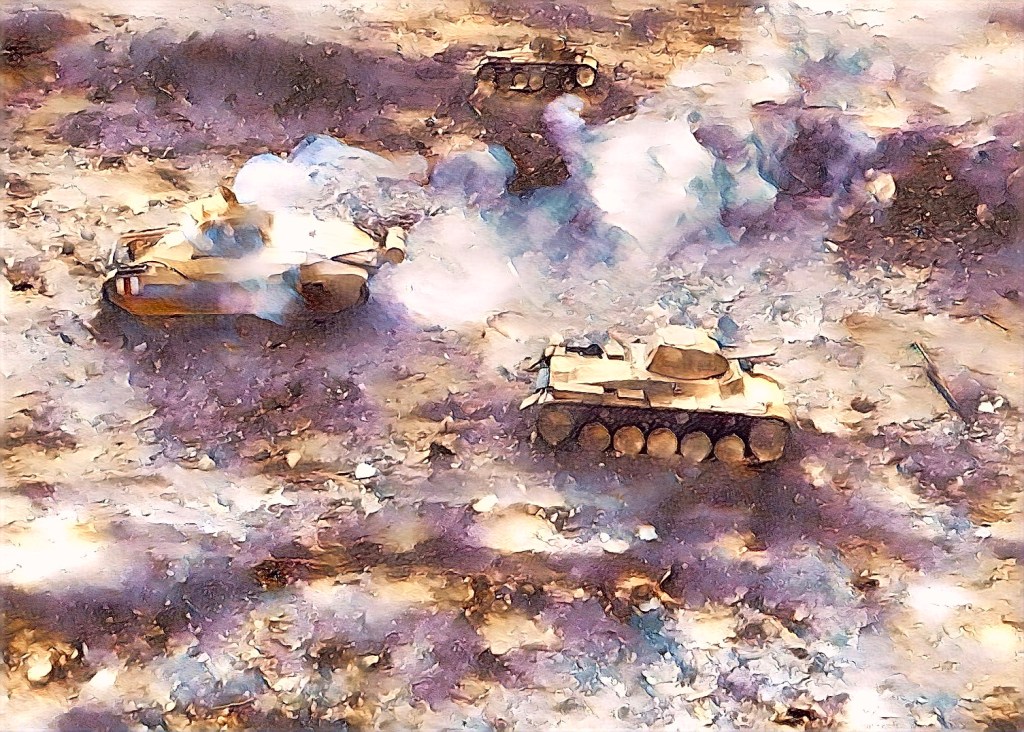

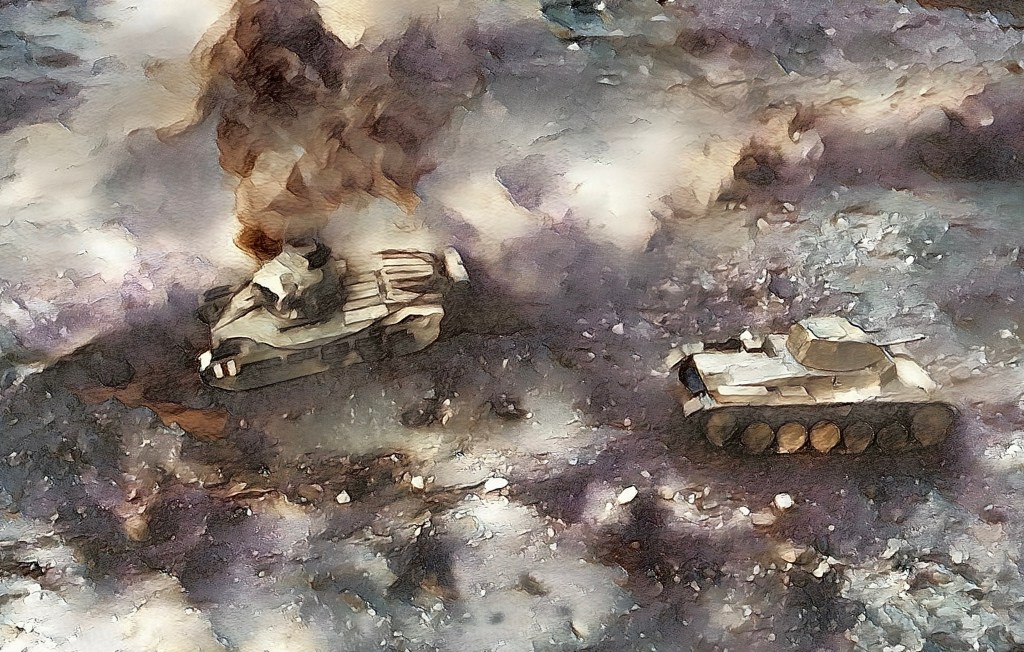
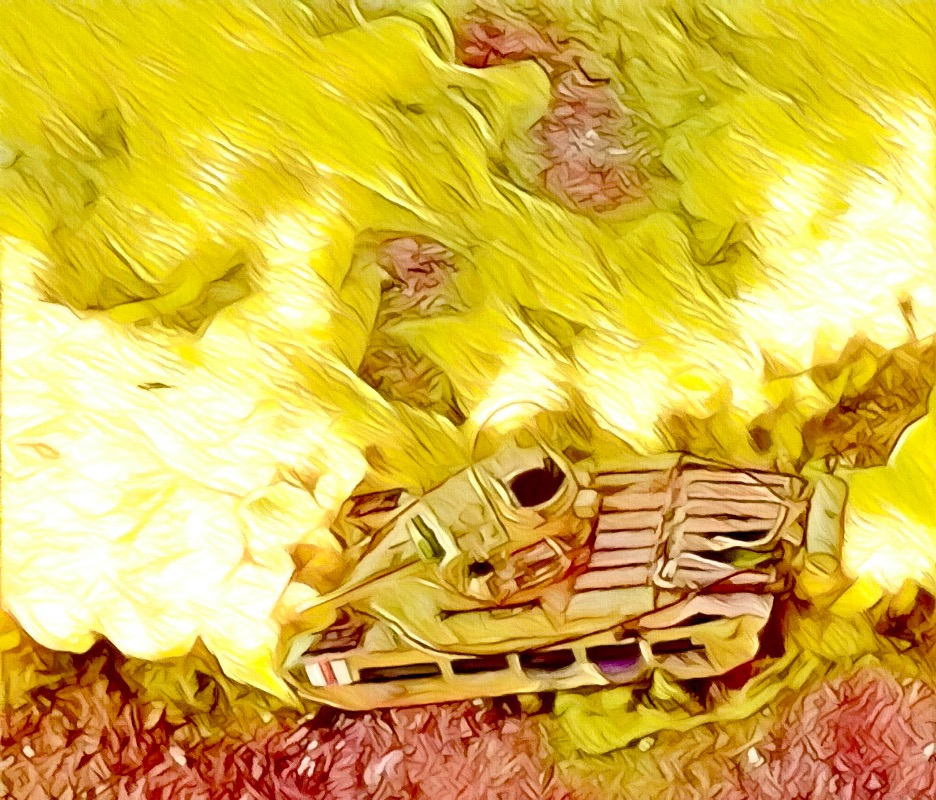
Matilda tanks won fame as “Queen of the Desert” during Operation Compass (December-February 1940-41), stopping everything the Italians threw at them.
During Operation Battleaxe against Germans in June of 1941, the 88 and other anti-tank guns made quick work of the Matilda. The British tanks were not destroyed by German tanks, they were lured into traps where the 88s could take out a Matilda from a mile and a half away.
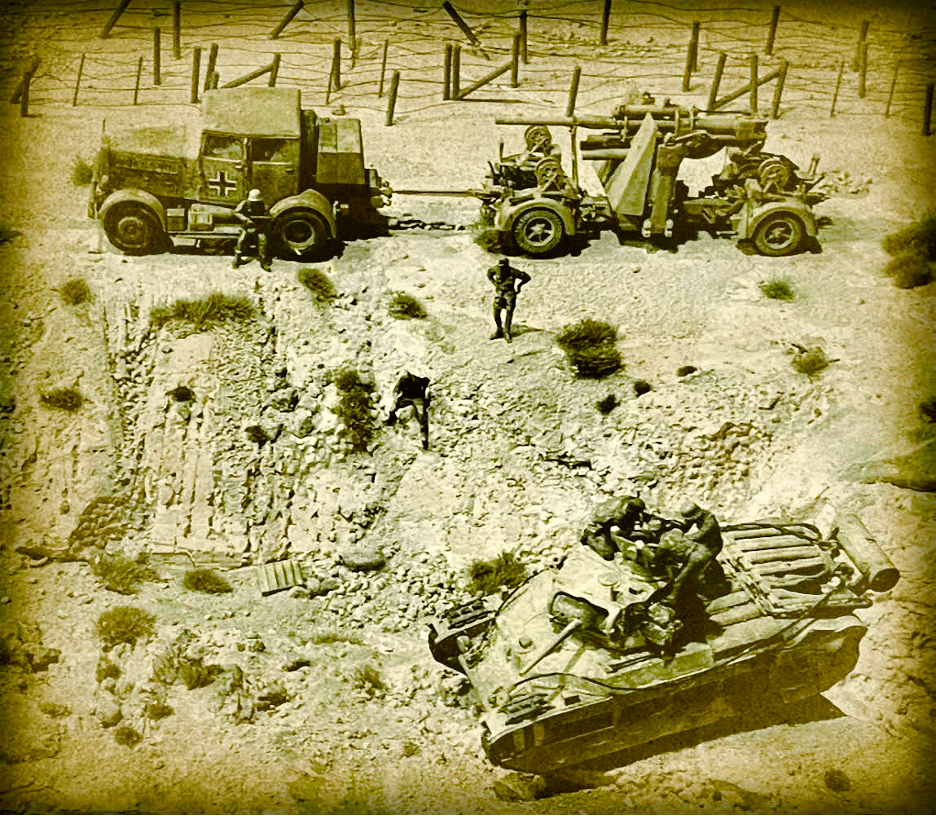
Diorama: June 1941. North Africa. A German 88 anti-tank crew, advancing over hard-fought ground during Operation Battleaxe, stops to check out the damage to one abandoned Matilda.
1/48 scale model and scratch-built desert diorama.
 WWII in North Africa