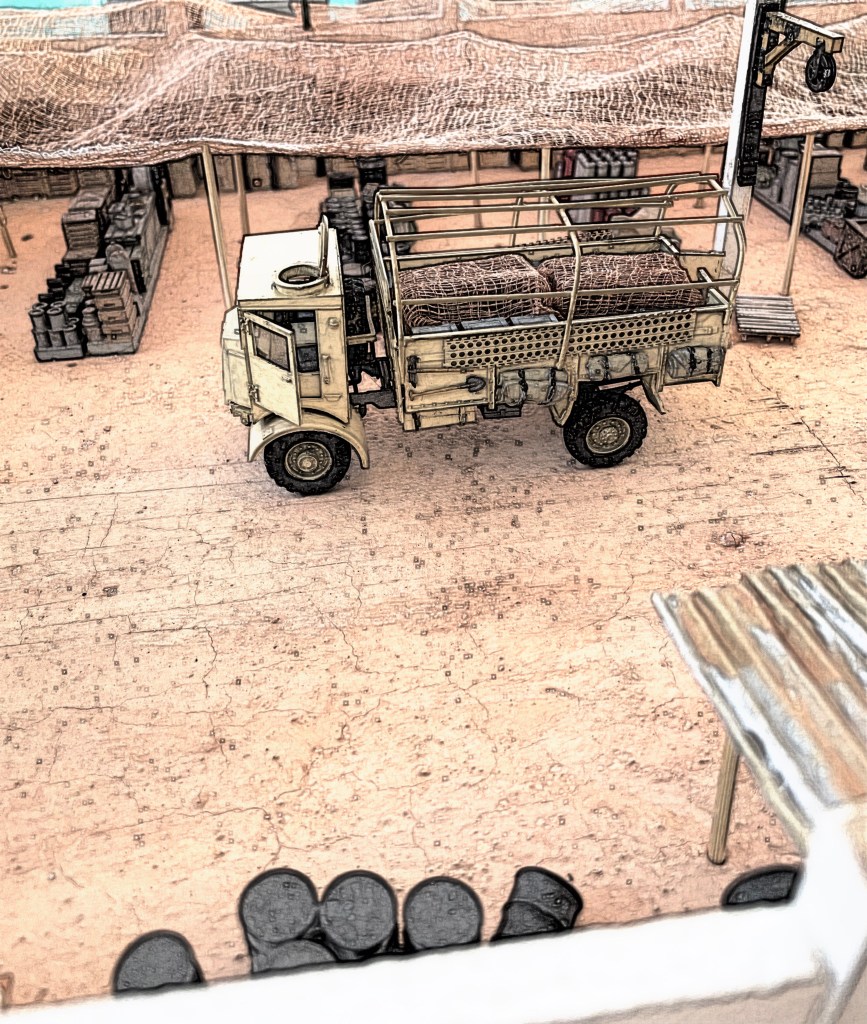
“Victory Depended on the 3-Tonner”
Bibliography with Notes plus Bonus Content
Braddock, David. Britain’s Desert War in Egypt and Libya, 1940-1942: ‘The End of the Beginning’. Yorkshire: Pen & Sword Books, 2019. Kindle.
Chapter 3 The First British Offensive (2)
“By the end of the month a combination of old vehicles, and ceaseless use by tired drivers over bad country in difficult climatic conditions had led to 40 per cent [sic] wastage in vehicles, and there were no large repair workshops within easy reach.”
Braddock, David. Britain’s Desert War in Egypt and Libya, 1940-1942: ‘The End of the Beginning’. Yorkshire: Pen & Sword Books, 2019. Kindle.
Chapter 2 The First British Offensive (1)
“For the commanders the desert’s main characteristic was that it produced nothing for the support of armies and all that was required for operations and human survival had to be carried there from more favoured [sic] areas.”
Stockings, Craig. The Battle of Bardia. (Australian Army Campaigns Series Book 9). Sydney: Big Sky Publishing, 2011. Kindle.
CHAPTER 5: Thrusting South
“as is evident from General O’Conner’s comment that ‘victory depended on the three-tonner.’”
Wahlert, Glenn. The Western Desert Campaign 1940-1941
(Australian Army Campaigns Series Book 2). Sydney: Big Sky Publishing, 2011. Kindle.
Chapter: Opening Moves
“It was one of those ironies of war in the Western Desert that the further an army advanced, the harder it was to keep the forces supplied. Initially, the Italians were at a disadvantage after their advance into Egypt. However, as the Italians retreated their supply situation actually improved. Conversely, the British were initially well supplied from their bases within Egypt, but became severely stretched as they chased the Italians back…”
Wahlert, Glenn. The Western Desert Campaign 1940-1941
(Australian Army Campaigns Series Book 2). Sydney: Big Sky Publishing, 2011. Kindle.
Chapter: The Leaders
“To help overcome the shortage of transport, the British became adept at utilizing supply dumps. In preparation of the opening of O’Conner’s offensive in 1940, Wavell arranged for dumps of ammunition, water and petrol to be positioned between the British lines and those of the Italians. ‘Several days’ supplies for the whole force were actually stored some 20 to 30 miles in advance of our fortified lines…’”
Wahlert, Glenn. The Western Desert Campaign 1940-1941
(Australian Army Campaigns Series Book 2). Sydney: Big Sky Publishing, 2011. Kindle.
Chapter: The Leaders
“The desert has often been called a tactician’s paradise and a quartermaster’s hell. Certainly, supply was the dominant issue of the war for both sides, as is evident from General O’Conners quote that ‘victory depended on the 3-tonner.’”
“…Everything had to be carried, including soldiers. Additionally, the distances over which supplies had to be carried were greater than any British experience in European wars and the wear and tear on the vehicles was immense.”
Wahlert, Glenn. The Western Desert Campaign 1940-1941
(Australian Army Campaigns Series Book 2). Sydney: Big Sky Publishing, 2011. Kindle.
Chapter: The Strategic Setting
“In this way the desert was analogous to the sea. Indeed, the Australian journalist Alan Moorehouse…described it thus: ‘Each tank or truck was as individual as a destroyer, and each squadron of tanks or guns made great sweeps across the desert as a battle-squadron at sea will vanish over the horizon..’”
Bonus Illustrations

 WWII in North Africa