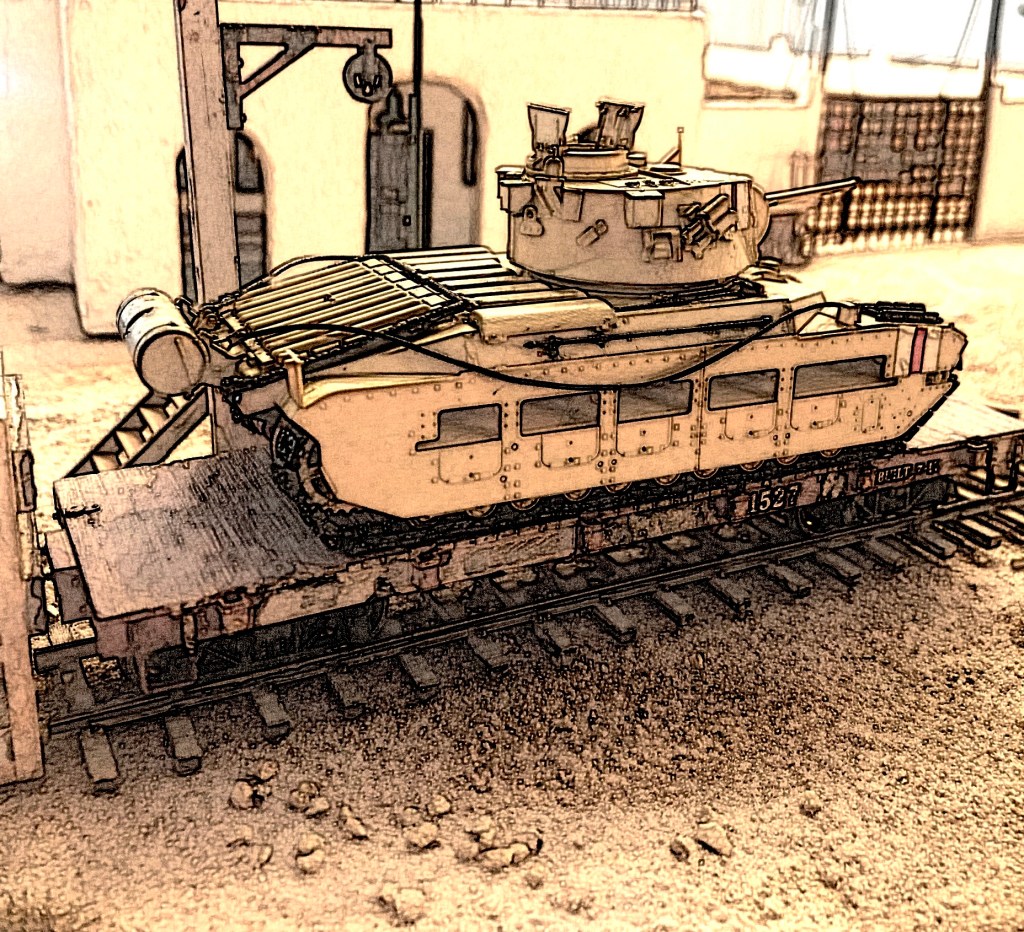
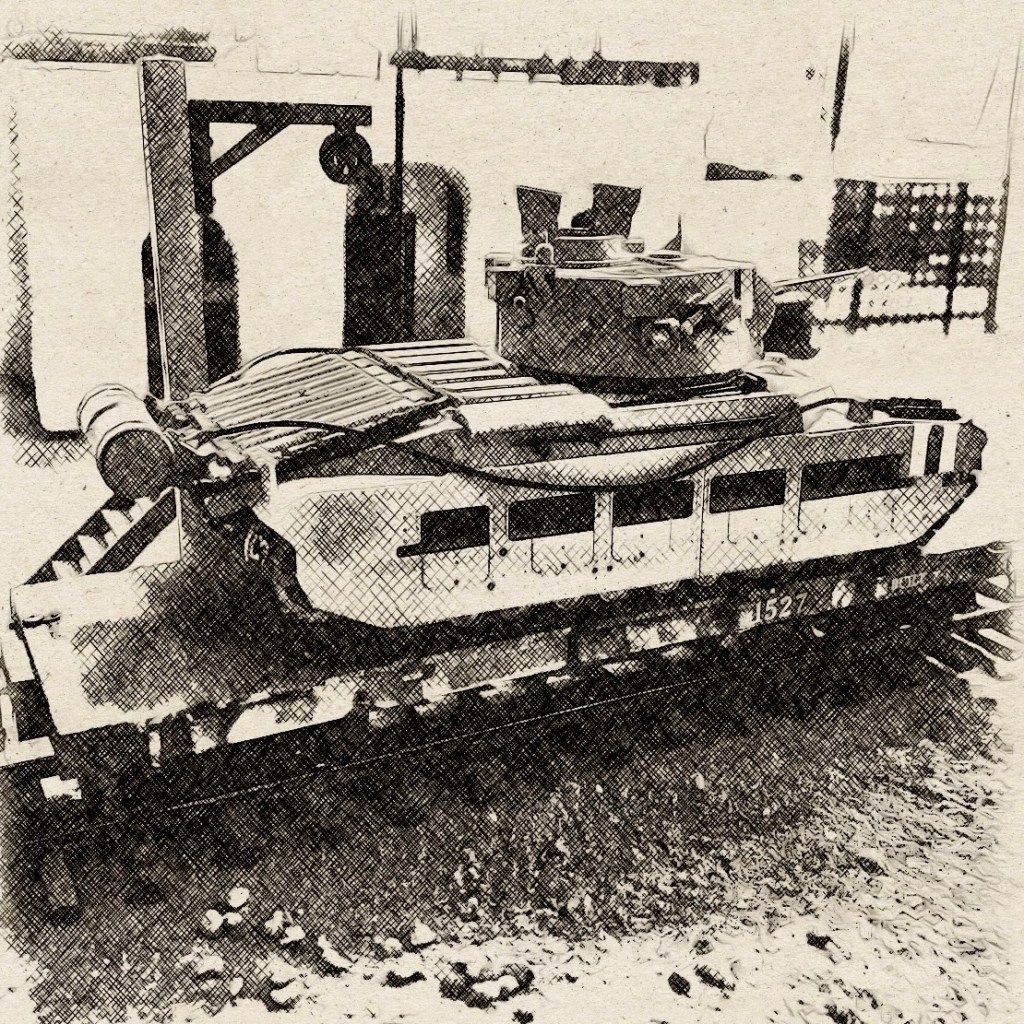
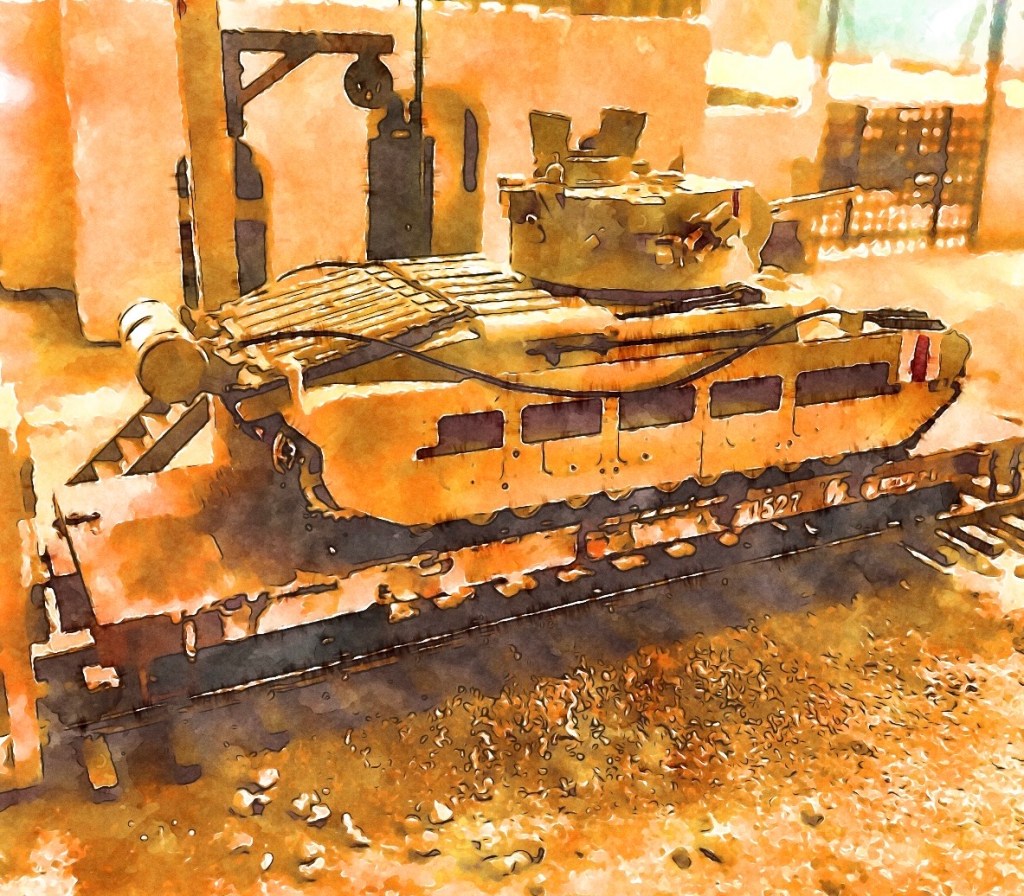
The Queen Arrives by Rail
Bibliography with Notes plus Bonus Content
Bierman, John and Colin Smith. War Without Hate. New York: The Penguin Group, 2002, p. 46.
“Named after a popular feathered cartoon character of the time because its 27-tons moved about as elegantly as an overweight duck, the Matilda averaged no more than six miles an hour over rough desert. …its main armament was a two-pounder canon whose range and penetrating power left a lot to be desired; but what the Matilda did have was three inches of armor plate, a hide impenetrable to almost anything the Italians had to offer.”
Joly, Cyril. Take These Men: Tank Warfare with the Desert Rats. Yorkshire/ Philadelphia: Pen and Sword Books, 2019. Kindle.
Chapter: A Squadron to Command
“A month later we got our orders to move back to the desert. The tanks were to be loaded onto the train at Gizeh station, and would detrain the following day in the desert south of Sidi Barrani.”
Judd, Brandon. The Desert Railway: The New Zealand Railway Group in North Africa and the Middle East during the Second World War. Auckland: Publishing Press, 2003. https://www.nzsappers.org.nz/wp-content/uploads/2020/04/The-Desert-Railway.pdf
Chapter 26 WRATH OF THE LUFTWAFFE
“As well as aerial attack, a railway line is peculiarly susceptible to sabotage. One of the great advantages the railway gave the British was the ability to load brand-new armoured fighting vehicles and tanks directly onto flat-top wagons from the ships at Suez ports, and rail them straight to the front line. These trains ran as ‘express trains’, such was their value. On reaching their destinations, they were rapidly unloaded and dispersed, ready for battle. The enemy wanted these trains disrupted or halted completely, and saboteurs must have gone out of their way to impede their progress as much as possible.”
Latimer, Jon. Operation Compass. Oxford: Osprey Publishing, 2000. Kindle.
Chapter: Opposing Forces
“Most significant were the Matildas operated by 7th Bn, Royal Tank Regiment. They were designed for infantry and created an enormous shock, being virtually impregnable.”
Latimer, Jon. Operation Compass. Oxford: Osprey Publishing, 2000. Kindle.
Chapter: The Campaign
“The Infantry Tank Mk II (A14) Matilda was the most powerful tank in the British inventory. Built to withstand all known anti-tank guns, it provided a shock to Irwin Rommel’s 7th Panzer division at Arras in May (France)…It also was mechanically complicated and slow, with a flat-out maximum speed of 15 mph (24 km/h.).”
Stockings, Craig. The Battle of Bardia. (Australian Army Campaigns Series Book 9). Sydney: Big Sky Publishing, 2011. Kindle.
Chapter 5: Thrusting South
“..had a track blown off by anti-tank fire. As the track alone weighed over a ton, and the tank over 30 tons, there was no chance of making field repairs.”
Stockings, Craig. The Battle of Bardia. (Australian Army Campaigns Series Book 9). Sydney: Big Sky Publishing, 2011. Kindle.
Chapter: Epilogue
“Thus far in the war there had been little for Australians to celebrate. After the fall of France…and with concern mounting over the future military intentions of Japan, Bardia was welcome news. One important result was an increase in AIF (Australian Imperial Forces) recruiting.
In Britain news of the battle was described as ‘tonic to the British people’, at a time when a dose was certainly required…the importance of such victories for political leverage within the US. This was particularly so because President Franklin Roosevelt’s determination to progress Lend Lease legislation through Congress was materially aided by victories like Bardia, demonstrating that Britain was an ally with a chance…”
Stockings, Craig. The Battle of Bardia. (Australian Army Campaigns Series Book 9). Sydney: Big Sky Publishing, 2011. Kindle.
Chapter 7: Endgame
“Field Repair. The desert terrain was particularly harsh on tanks. If a tank or truck broke down, and could not be repaired immediately, it was often quickly stripped of much needed parts before removal to the rear.”
Wahlert, Glenn. The Western Desert Campaign 1940-1941
(Australian Army Campaigns Series Book 2). Sydney: Big Sky Publishing, 2011. Kindle.
Chapter: Australian, British and Italian Forces
“…Matilda’s were particularly valuable in the early days of the Western Desert campaign, where the Matilda was virtually invulnerable to Italian tank and anti-tank guns, earning it the title ‘Queen of the Battlefield’. After the battle for Bardia in January 1941, one Matilda crewman counted 38 dents from Italian guns, none of which had penetrated.”
Bonus Illustrations
 WWII in North Africa