The British Tin Flimsy
Bibliography with Notes plus Bonus Content
Hanson, Jonathan. Irreducible imperfection: The flimsy. ExploringOverland.com https://www.exploringoverland.com/overland-tech-travel/2012/8/17/irreducible-imperfection-the-flimsy.html
“Stacked in pallets on cargo ships, the weight of the top layers simply crushed those below, resulting in fuel losses of up to 40 percent, and making unloading the intact containers extremely hazardous with thousands of gallons of petrol sloshing around in the bilges and the fumes powerful enough to render seamen unconscious, not to mention the danger of fire or explosion.”
“Truck transport over 100 miles of desert track frequently left 20 to 30 percent of the contents cascading out the tailgate.””
“…a single Wellington bomber flying a single nine-hour sortie needed 270 flimsies to fill its tanks. Piles of empty containers 30 feet high stood outside every airbase, and littered the Western Desert wherever British vehicles ranged.”
“Filled with sand, it became an impromptu building block for gun emplacements and buildings. Cut in half and filled with petrol-soaked sand, it was used as a stove for boiling water (in another half-flimsy), and known as a Benghazi burner or Benghazi boiler…”
Joly, Cyril. Take These Men: Tank Warfare with the Desert Rats. Yorkshire/ Philadelphia: Pen and Sword Books, 2019. Kindle.
Part Four, Chapter Four: SURROUNDED IN LEAGUER
“…There was further delay while the lorries did their round of the tanks, delivering the cans of petrol. There was even further delay because so many of the cans proved to be empty. The cans were the tin, four-gallon type…when packed two to a wooden crate had been fairly satisfactory. By winter of 1941, due to the shortage of wood, they were packed in cardboard boxes or thin plywood cases. In either case the tins were soon dented or holed and the wastage of petrol was immense.”
Latimer, Jon. Operation Compass. Oxford: Osprey Publishing, 2000. Kindle.
Chapter: The Campaign
“The fuel trucks had difficulty keeping up, and the increased fuel consumption was exacerbated by the damage inflicted on the flimsy fuel and water containers crashing around, many of which broke, leaking their precious fluids into the sand.”
Shaw, W.B. Kennedy. Long Range Desert Group: Behind Enemy Lines in North Africa. Yorkshire: Frontline Books, 2015. Kindle.
CHAPTER THREE: FIRST SORTIES
“The transport of petrol for long distances over bad going was a difficult problem. Until the capture of Benghazi for the second time gave us a supply of German ‘Jerricans,’ we carried our petrol in four-gallon, non-returnable tins, packed two to a wooden case. At the beginning of the Libya campaign when wood for cases was plentiful, the method was fairly satisfactory, but later on, when the strong wooden cases were replaced by cardboard boxes, or by plywood crates, the loss of petrol by leakage was very high. Sand stuck to the damp tins and made a sort of grinding paste; this and careless loading at railhead and at dumps soon punctured the thin metal. Twenty-five percent was a normal loss and on long journeys across rough country it would be much higher…”
Bonus Illustrations
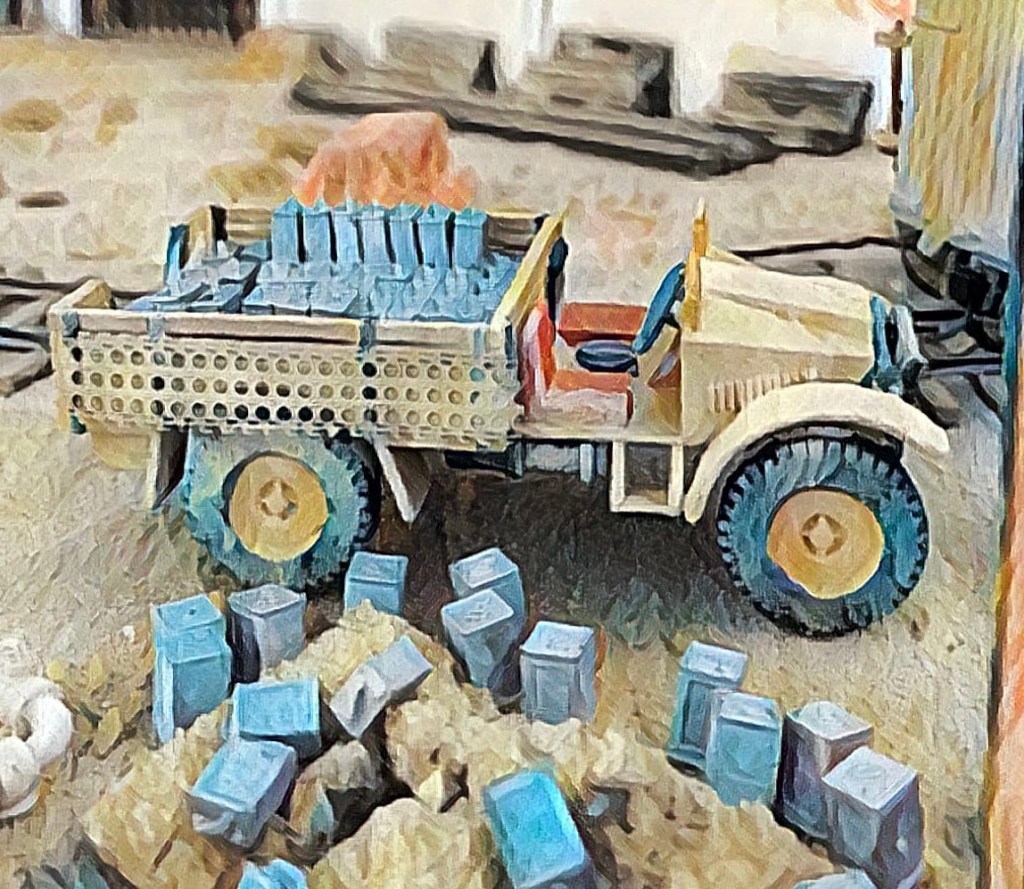
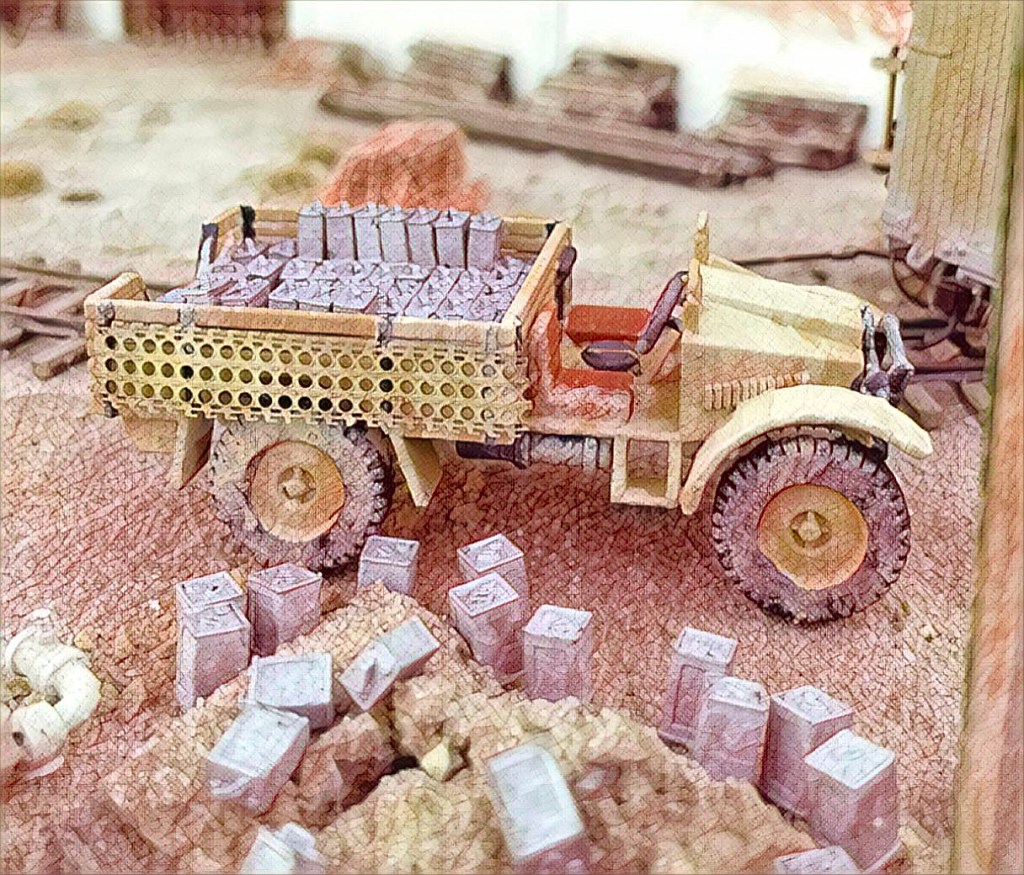
 WWII in North Africa