Pipeline to Victory Part 2
Bibliography with Notes plus Bonus Content
Judd, Brandon. The Desert Railway: The New Zealand Railway Group in North Africa and the Middle East during the Second World War. Auckland: Publishing Press, 2003. https://www.nzsappers.org.nz/wp-content/uploads/2020/04/The-Desert-Railway.pdf
Chapter 8 OFFENSIVE AND COUNTER-OFFENSIVE
“During the offensive 19th Army Troop sappers were working with desperate speed to complete the (water) pipeline. By mid-December Joey had achieve limited operation to El Hammam, 60 miles east of El Dabaa. After that only part of the water required had to transported from Alexandria [by rail].”
Judd, Brandon. The Desert Railway: The New Zealand Railway Group in North Africa and the Middle East during the Second World War. Auckland: Publishing Press, 2003. https://www.nzsappers.org.nz/wp-content/uploads/2020/04/The-Desert-Railway.pdf
Chapter 19 THE LULL BEFORE THE STORM
“Still on the subject of supply: it is on record that in an earlier campaign about 100 German troops surrendered to British forces simply because they had not been supplied with drinking water in the previous 36 hours. They had, in fact, overrun a branch supply pipe still being installed by our troops. Gleefully, the Germans broached this pipeline and drank freely of its contents. Too late they realised that they were drinking salt water which was intended only for testing for leaky joints. That salt water, combined with thirst and desert heat produced a degree of delirium among the German troops who surrendered to their foes in order to get good drinking water and some relief for their afflictions.”
Rainier RE, Major Peter. Pipeline to Battle: An Engineer’s Adventures with the British Eighth Army. Auckland: Pickle Partners Publishing, 2013. Kindle.
PART ONE Chapter 9: A Bedouin Strike
“…The success of any operation might well hinge on the amount of water we could push through. Half a gallon daily was the men’s ration. The more half gallons available in the front line, the more men Wavell could throw into the fight, if he had the men…”
Rainier RE, Major Peter. Pipeline to Battle: An Engineer’s Adventures with the British Eighth Army. Auckland: Pickle Partners Publishing, 2013. Kindle.
PART ONE Chapter 9: A Bedouin Strike
“Next was the question of pipe distribution. In those days we had no mammoth pipe trailers such as we later used to carry loads of pipe across the desert. But if I dug my ditch alongside the railway the pipe could be distributed from trains.”
Rainier RE, Major Peter. Pipeline to Battle: An Engineer’s Adventures with the British Eighth Army. Auckland: Pickle Partners Publishing, 2013. Kindle.
PART ONE Chapter 10: Sabotage
“…The success of any operation might well hinge on the amount of water we could push through. Half a gallon daily was the men’s ration. The more half gallons available in the front line, the more men Wavell could throw into the fight, if he had the men…”
Rainier RE, Major Peter. Pipeline to Battle: An Engineer’s Adventures with the British Eighth Army. Auckland: Pickle Partners Publishing, 2013. Kindle.
PART FIVE Chapter 2: The Taking of the Mareth Line
“The only time I ever knew the Eighth Army to be really worried was Medenine. One of the French officers attached to us spread the story that the water in Southern Tunisia had the property of making men impotent. There was a stir when this got around.
“The Medical Corps was bombarded with telephone calls from frantic officers who said their troops were almost killing themselves with thirst because they were afraid to drink more than a minimum of the dangerous fluid which I was supplying in the water carts.
“…Well, give them something to put in the water so as to keep them satisfied…So all my water points used to put a spoonful of harmless lime into each water cart, and the English Army stopped worrying.”
Rainier RE, Major Peter. Pipeline to Battle: An Engineer’s Adventures with the British Eighth Army. Auckland: Pickle Partners Publishing, 2013. Kindle.
PART ONE Chapter 8: A Job of Pipe
“It seemed with the growth of the Army the difficulty of water supply to the desert was daily increasing. That I knew. Who should better know than a railroad officer the growing proportion of tank trains carrying water on the now congested single track railway that we still our main line of communication between the Army and the base at Alexandria?
“…who had conceived the idea of a desert pipeline connected with the municipal water supply from the city of Alexandria. With a string of pumping stations in the desert.”
Rainier RE, Major Peter. Pipeline to Battle: An Engineer’s Adventures with the British Eighth Army. Auckland: Pickle Partners Publishing, 2013. Kindle.
PART THREE Chapter 1: The High Tide of Retreat
“Then as the battle broke off, and astounding thing happened. More than 1,100 Germans walked across our line with their hands in the air.
“Thirst had done it. Their tongues were literally hanging out of their mouths. For thirty-six hours they had had no fresh water to drink. That pipeline, full of salt water, was the cause. The sea water in it had increased their thirst almost to the point of delirium. If the Alamein defense line had been complete, as it should have been, that pipeline would have been full of fresh water…”
Rainier RE, Major Peter. Pipeline to Battle: An Engineer’s Adventures with the British Eighth Army. Auckland: Pickle Partners Publishing, 2013. Kindle.
PART TWO Chapter 6: The Knightsbridge Battle
“…When the new Gazala-Bir Hakim line had been consolidated after the last battle of the frontier, the railway was extended to recently relieved Tobruk, about another 100 miles.
“The original Western Desert pipeline, the first section of which I had constructed more than a year before, was extended beyond Fort Capuzzo, over the Libyan border. Nile water was now in what once had been Italian territory.”
Rainier RE, Major Peter. Pipeline to Battle: An Engineer’s Adventures with the British Eighth Army. Auckland: Pickle Partners Publishing, 2013. Kindle.
PART ONE Chapter 11: Tanks—At Last
“My pipeline was finished by this time, pumping Alexandria water through to Daba, 100 miles westward and saving daily 500 tons of railway freight. Consequently, each day 500 tons more of military supplies could now go west. At Daba the water was tanked and hauled by rail the rest of the way to Mersa Matruh. From Mersa westward, beyond railhead, there was another pipeline under construction.”
Rainier RE, Major Peter. Pipeline to Battle: An Engineer’s Adventures with the British Eighth Army. Auckland: Pickle Partners Publishing, 2013. Kindle.
PART TWO Chapter 6: The Knightsbridge Battle
“…Here and there lay groups of Sandhills, karms the Bedouin called them for a pipeline, a road or railway. The proof of ancient civilization lay beneath them. Once I uncovered a complete system of underground resevoirs, large circular chambers connected with underground passages. Inside they were plastered with a lime-made cement which was still water tight, at least 1,500 years after it was applied. There were other things under the karms too, buried deep by the centuries of windblown sand. Under one there were three alabaster pillar lying side by side. They were turned as precisely as though executed by a modern machine. Other mounds yielded the foundations of house and a dozen different kinds of relics which told of a richly settled neighborhood.”
Bonus Illustrations
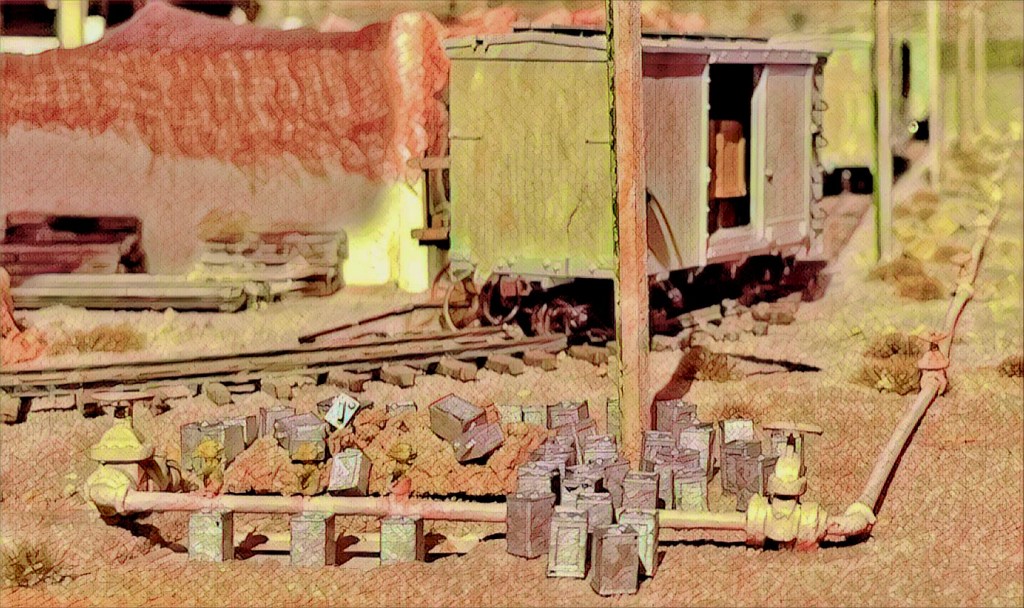
 WWII in North Africa