Pipeline to Victory Part 1
Bibliography with Notes plus Bonus Content
Braddock, David. Britain’s Desert War in Egypt and Libya, 1940-1942: ’The End of the Beginning’. Yorkshire: Pen & Sword Books, 2019. Kindle.
Chapter 3 The First British Offensive
“Another constant anxiety was the shortage of water and for some days the personal ration was cut to half a gallon a day for all purposes. The navy then brought up 3,500 tons from Alexandria, and though a great deal was lost by wastage, there being very few desert-worthy water carts, by the end of the month the situation had improved markedly…”
Delve, Ken. The Desert Air Force in WWII: Air Power in the Western Desert 1940-1942. South Yorkshire: Pen & Sword Books, Ltd, 2017. Kindle.
Chapter 3: From Victory to Defeat and Stalemate
“Life in camp centered on boredom, lack of palatable drinking water (it was invariably highly chlorinated, very salty and dispensed from a bowser)…
Joly, Cyril. Take These Men: Tank Warfare with the Desert Rats. Yorkshire/ Philadelphia: Pen and Sword Books, 2019. Kindle.
Chapter Four The Weary Vigil
“…Some men preferred the water by itself, others mixed with
fruit juice or lemonade tablets. We were always affected by the quality of the water, which was often the greatest tribulation which had to be endured. Usually it was fairly good and tasted reasonably sweet despite the disinfectant prescribed by the doctors. Sometimes, however, it was brackish, salty and discoloured…The milk curdled in the tea, the sugar seemed to have no effect; the water was loathsome by itself and equally vile when mixed with anything else.”
Joly, Cyril. Take These Men: Tank Warfare with the Desert Rats. Yorkshire/ Philadelphia: Pen and Sword Books, 2019. Kindle.
Chapter Four The Weary Vigil
“Water, too, was always a problem and, except for the troops who were near to the supply points, was limited to never more than three-quarters of a gallon per man per day. Separated as we were from the main water points at Matruh by so great a distance, we were limited to a mere half gallon per man per day. This four pints was all that each man could expect…one pint was heated and used for washing and shaving…Each day’s supply was caught and kept…by the end of the week or ten days was sufficiently full to provide a bath of sorts. After the bath, the water was again filtered and used for washing clothes. Finally after another filtering it was used in the radiators of the lorries and trucks.
“Another pint was kept in a water-bottle as emergency supply which we could consume each day…
“The two remaining pints were issued to mess or cook house, one pint for making tea, the other to be used for cooking.”
Judd, Brandon. The Desert Railway: The New Zealand Railway Group in North Africa and the Middle East during the Second World War. Auckland: Publishing Press, 2003. https://www.nzsappers.org.nz/wp-content/uploads/2020/04/The-Desert-Railway.pdf
Chapter 4 INTO THE WESTERN DESERT
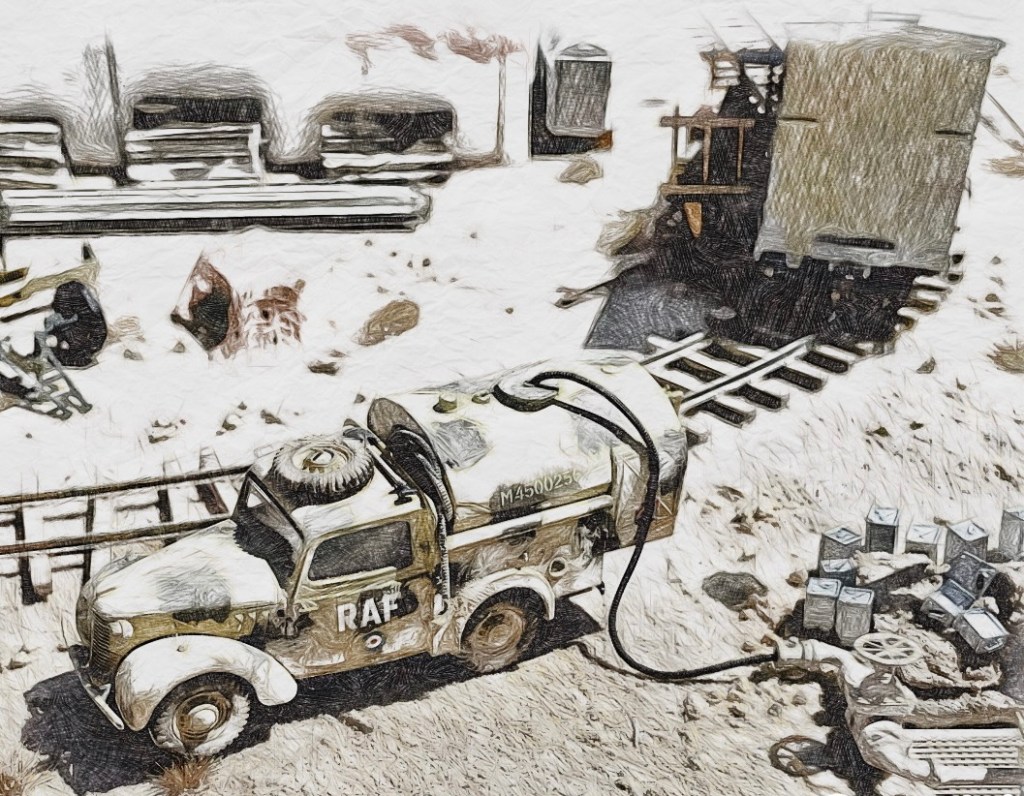
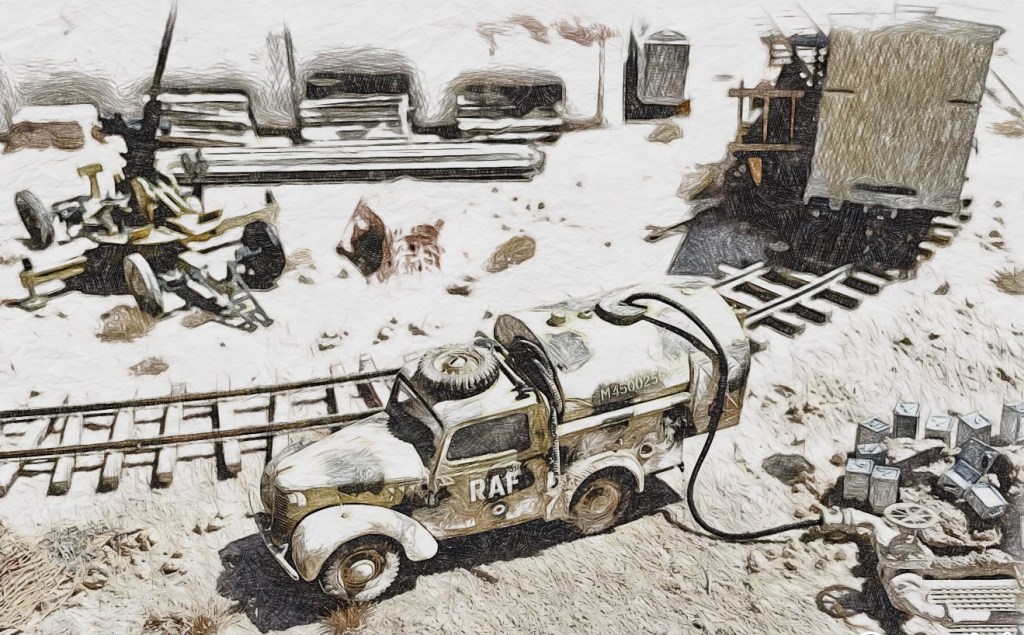
“However, there was one important piece of equipment that could not be initially supplied—a water cart…eventually a water bug (tank on a truck) was located and assigned to the railway group.”
Moorehead, Alan. The Desert War: The Classic Trilogy on the North African Campaign 1940-1943. London: Aurum Press Ltd, 2013. Kindle.
BOOK ONE—The Mediterranean Front: The Year of Wavell 1940-41: One
“The road leading from Mersa Matruh to Sidi Barrani was still good at this time. Camouflaged water-wagons bound for forward units were moving along, averaging perhaps six or seven miles an hour. At intervals of twenty or so miles little groups of these supply wagons turned off into the open desert to the south…Except in action, there was wireless silence and communications were kept up by a few light aircraft and motorcyclists.”
Bonus Illustrations
 WWII in North Africa