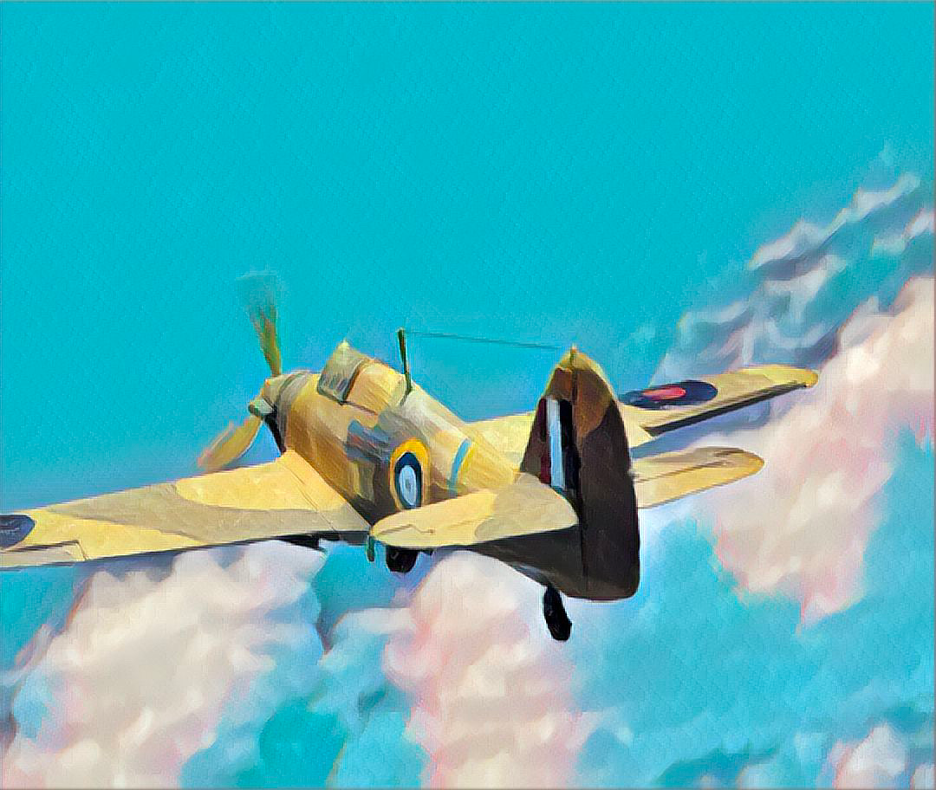
British Hawker Hurricane
Bibliography with Notes plus Bonus Content
Bickers, Richard Townshend. The Desert Air War: a gripping historical account of the RAF’s role in North Africa during World War II. UK: Lume Books, 2018. Kindle.
Chapter One
“Dyson had used most of his 14.8 seconds’ worth of ammunition…he began to twist and jink among the Fiats, which needed less space for their manoeuvres than a Hurricane…”
Bickers, Richard Townshend. The Desert Air War: a gripping historical account of the RAF’s role in North Africa during World War II. UK: Lume Books, 2018. Kindle.
Chapter Two
“The opposing aeroplanes were fairly evenly matched. The Gladiator, the R.A.F.’s last biplane fighter, was obsolescent and being replaced by the Hurricane and Spitfire. It had a maximum speed of 253 mph and was armed with four .303 inch machine guns. The Fiat CR42 fighter, also a biplane, could attain 267 mph and had two 12.7 mm machine guns. The Blenheim Mk IV’s top speed was 285 mph, its range 1,125 miles and bomb load 1,000 lb. The Savoia-Marchetti S79 bomber had best speed of 270mph, a range of 1,243 miles and could carry 2,200 lbs of bombs.”
Bickers, Richard Townshend. The Desert Air War: a gripping historical account of the RAF’s role in North Africa during World War II. UK: Lume Books, 2018. Kindle.
Chapter Two
“…A section of two Blenheims and a Hurricane—which became known as ‘Collie’s battleship’ —was formed and attached to 33 Squadron on the newly built landing ground at Ma’aten Gerwala. Collishaw tried to bluff the enemy into thinking he had several Hurricanes by operating his solitary one from different landing grounds.”
Bickers, Richard Townshend. The Desert Air War: a gripping historical account of the RAF’s role in North Africa during World War II. UK: Lume Books, 2018. Kindle.
Chapter Two
“The best news of the day was delivered by 33 Squadron, one of whose defensive patrols forward reported the arrival of three Hurricanes from England, making a total of four in Egypt, but with the promise of more to come.”
Noronha, Joseph. The Heroic Hawker Hurricane. SP’s Aviation. https://www.sps-aviation.com/story/?id=3171&h=The-Heroic-Hawker-Hurricane
“An advantage of this structure was that cannon shells could pass right through the wood and fabric covering without exploding, as numerous live engagements proved. Most damage to the airframe was relatively simple to repair, even by ground crew at the airfield. The enclosed cockpit was a first for RAF pilots.“
Shores, Christopher F., and Giovanni Massimello with Russel Guest. A History of the Mediterranean Air War, 1940-1945: Volume One: North Africa. London: Grub Street, 2012. Kindle.
Chapter 2 The Opening Rounds
“…This unit had on hand the single Hawker Hurricane fighter available in the Middle East…an early Mk I which had been sent out from England…”
Shores, Christopher F., and Giovanni Massimello with Russel Guest. A History of the Mediterranean Air War, 1940-1945: Volume One: North Africa. London: Grub Street, 2012. Kindle.
Chapter 3 Graziani Makes a Move
“…The RAF had been struck hard by a decision of 5 September to suspend all deliveries of Hurricanes due to the losses of these aircraft being suffered in the U.K. (Battle of Britain). However, the improving situation there during October, and the reducing threat of imminent invasion as Autumn approached with its adverse weather in the English Channel…was able to proceed with the programme of re-equipment begun during the previous month.”
Shores, Christopher F., and Giovanni Massimello with Russel Guest. A History of the Mediterranean Air War, 1940-1945: Volume One: North Africa. London: Grub Street, 2012. Kindle.
Chapter 6 Reverses and Reinforcements
“It should also be mentioned that every squadron flying Hurricanes in the Middle East at this time were equipped with the Mark I version of the aircraft. This was at a time when Fighter Command in the UK was operating Mark II Hurricanes which were already considered to be outclassed by the opposition, and which were rapidly being phased out in favour of the Spitfire II and V.”
Shores, Christopher F., and Giovanni Massimello with Russel Guest. A History of the Mediterranean Air War, 1940-1945: Volume One: North Africa. London: Grub Street, 2012. Kindle.
Chapter One Background
“…It was employed…to fly in and out of the frontier airfields to give the impression that he had many more of these aircraft than was in fact the case.”
Wahlert, Glenn. The Western Desert Campaign 1940-1941
(Australian Army Campaigns Series Book 2). Sydney: Big Sky Publishing, 2011. Kindle.
Chapter: Weapons List
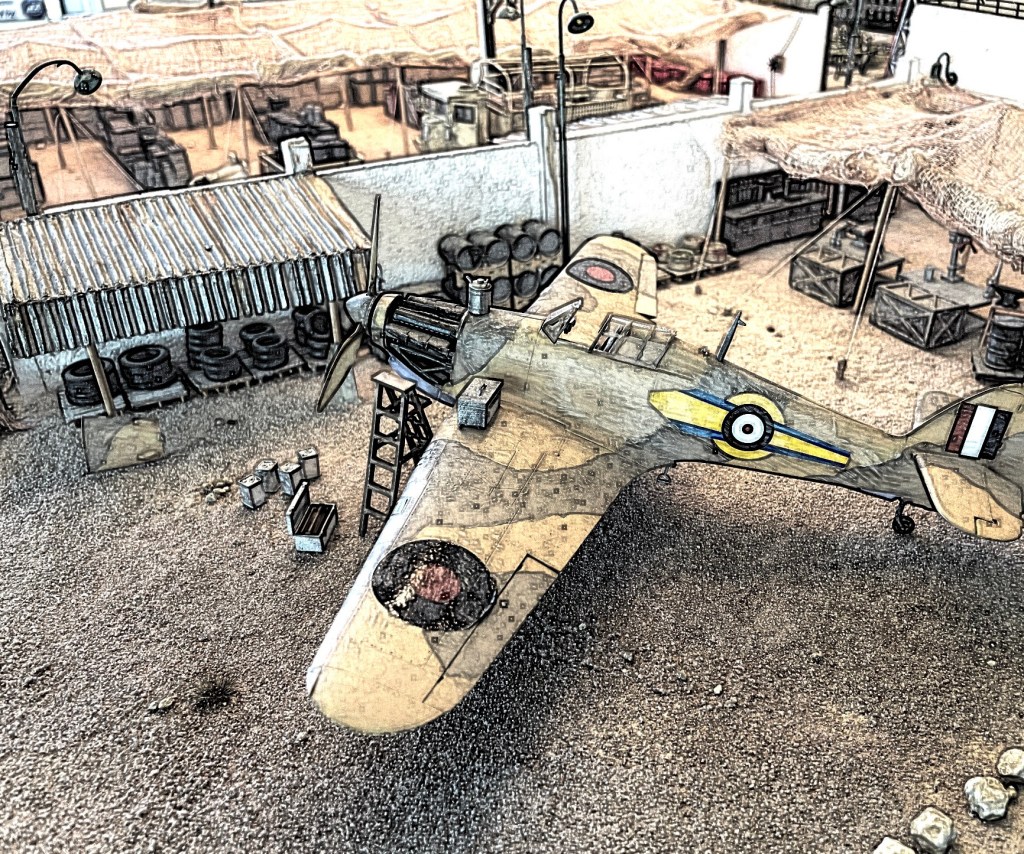
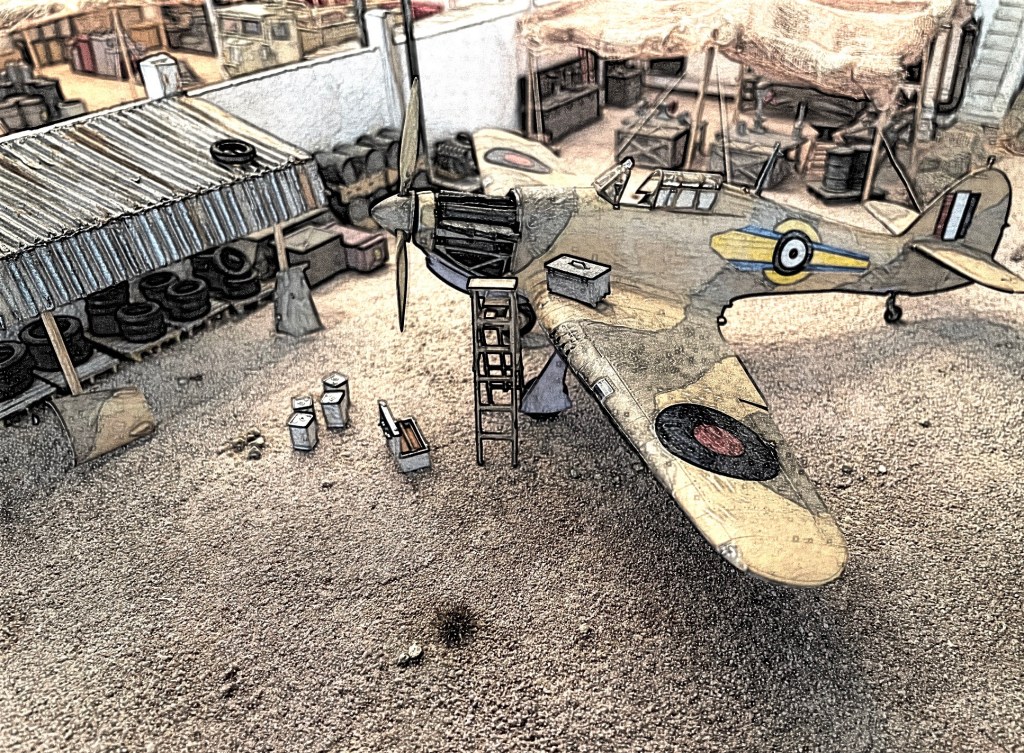
“When the Hawker Hurricane first appeared in 1935 it was the world’s most heavily armed fighter and Britain’s first to exceed 300 mph (483kph)…while the Mk II Hurricanes were entering operational service during the Western Desert Campaign, only the earlier Mk I was employed during this operation and they were ‘tropicalized’ in that they featured dust filters for the engine air intake and other modification to protect the aircraft from harsh desert conditions.”
Bonus Illustrations
 WWII in North Africa