The Road Watch: Long Range Desert Group–Part 2
Bibliography with Notes plus Bonus Content
Owen, Major-General David Lloyd. The Long Range Desert Group 1940-1945 Providence Their Guide, South Yorkshire: Pen & Sword Books Ltd, 2008. Kindle.
Part One—Chapter 2 The Patrol Structure
“…which these patrols were to operate behind enemy lines from September 1940 until two months before the fall of Tripoli in January 1943—a period throughout which there were always one or more Patrols at work.”
Owen, Major-General David Lloyd. The Long Range Desert Group 1940-1945 Providence Their Guide, South Yorkshire: Pen & Sword Books Ltd, 2008. Kindle.
Part One—Chapter 1 Ralph Bagnold
“Bagnold’s only claim to fame might otherwise have been the fact that he is the brother of well-known authoress Enid Bagnold.”
Owen, Major-General David Lloyd. The Long Range Desert Group 1940-1945 Providence Their Guide, South Yorkshire: Pen & Sword Books Ltd, 2008. Kindle.
Part One—Chapter 8 The Road Watch
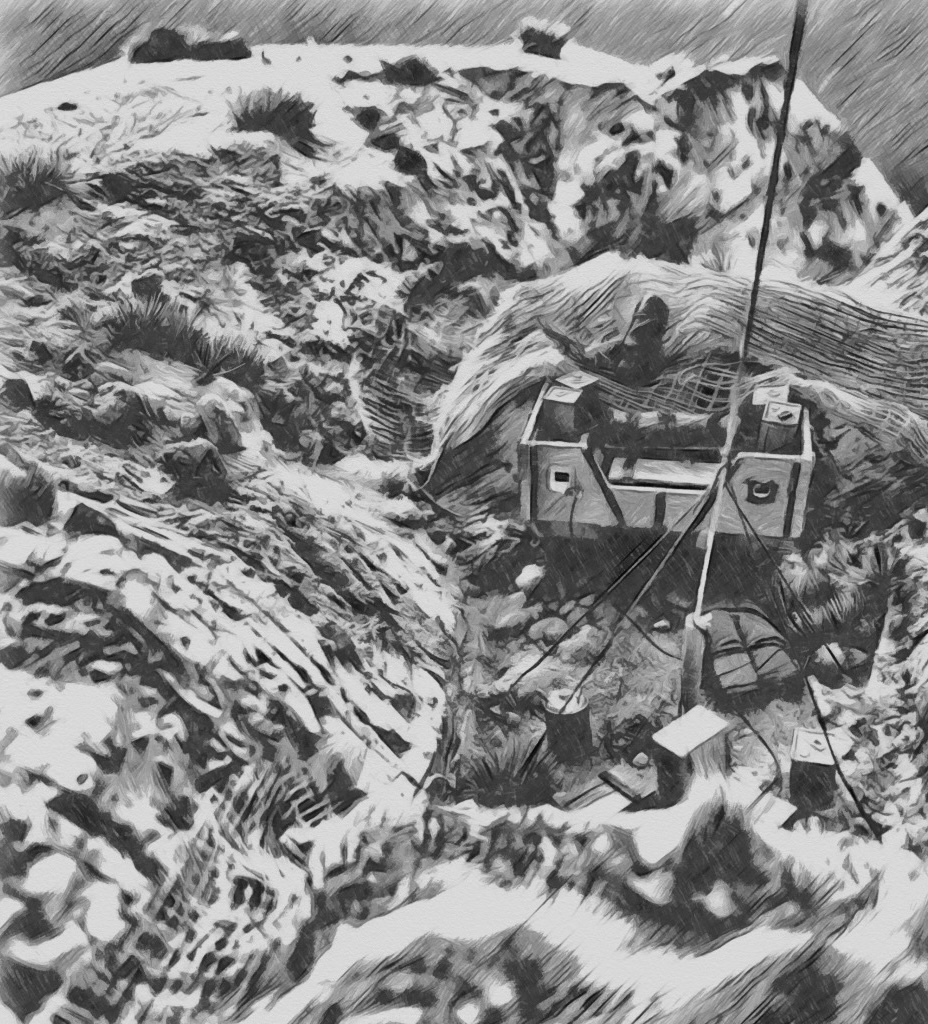
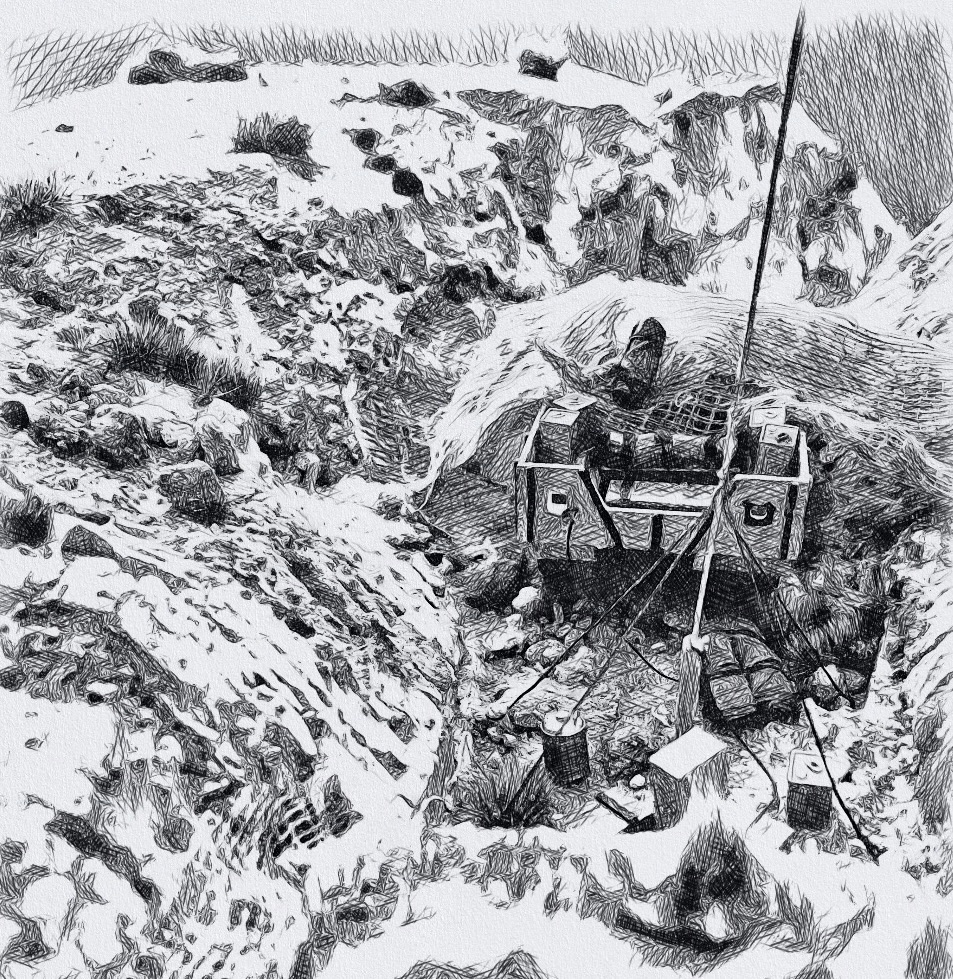
“Those who were back in the wadi had very little relief from boredom. They lay under their camouflage nets, and very often under mosquito nets as well to keep the flies at bay, just reading or, perhaps, listening to the wireless. There was little else that we could do, for we could not risk moving about much because of the constant possibility of being spotted from the air.”
Shaw, W.B. Kennedy. Long Range Desert Group: Behind Enemy Lines in North Africa. Yorkshire: Frontline Books, 2015. Kindle.
CHAPTER FOUR: MURZUK
“Procedure is a standardized way of sending signals and, because a good signalman can recognize his distant colleague merely by the way he dots his dashes, in much the same way as we recognize handwriting, the characteristic Army procedure was easy enough to distinguish. There was no harm in using this in places where the enemy would expect it, such as behind the British lines, but an intelligent Italian D.F. (direction finder) operator, hearing Army procedure in the direction of Murzuk when the front line was at Tobruk, could reasonably be expected to sit up and take notice. So L.R.D.G. used French commercial procedure, complete with call-signs, indicators, etc…and thus the watchful Italian would (or might) assume that he was merely listening to Algiers ordering a dozen of champagne and two barrels of oysters from Tunis.”
Shaw, W.B. Kennedy. Long Range Desert Group: Behind Enemy Lines in North Africa. Yorkshire: Frontline Books, 2015. Kindle.
CHAPTER THIRTEEN: THE ROAD WATCH
“At the camp after dark the wireless mast would go up and if tanks had gone by moving eastwards a signal would come to Group H.Q. at Siwa or Kufra and soon afterwards, perhaps when the tanks were nearing Agedabia, Ciphers at Middle East would be de-coding…”
Victoria University of Wellington Library. Episodes and Studies Volume 1: The Road Watch. https://nzetc.victoria.ac.nz/tm/scholarly/tei-WH2-1Epi-c1-WH2-1Epi-l-1.html
“Equipped with field-glasses, books of vehicle silhouettes, and notebooks, they lay full-length all day, watching the traffic on the road and recording the details of lorries, tanks, armoured cars, guns, and troops as they passed.”
Victoria University of Wellington Library. Episodes and Studies Volume 1: The Road Watch. https://nzetc.victoria.ac.nz/tm/scholarly/tei-WH2-1Epi-c1-WH2-1Epi-l-1.html
“The site of the watch was five miles to the east of Marble Arch, at a point where the road crosses a flat plain a short distance to the north of a low plateau. The patrols found sufficient cover to make camp and camouflage their vehicles in shallow wadis running down from the plateau. Before dawn each day, two men went out on the plain to select a hiding-place 300 or 400 yards from the road, where they concealed themselves as best they could on ground that was bare except for small, scattered bushes.”
Bonus Illustrations
Bonus Content
Like pirates of old flying false flags to confuse enemies, some LRDG patrols carried German and British markings and would display the “friendly” marking on the hoods of their trucks depending on who was flying overhead.
The Italian army had a unit like the LRDG called the Auto-Saharan
Company. These long-range patrols operated in close coordination with air support. They operated from the late 1930s until Italy surrendered in 1943.
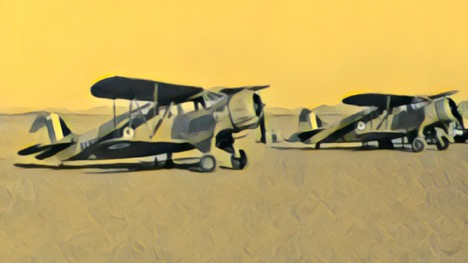
The LRDG had its own air force, two WACO passenger aircraft built in Ohio in the 1930s. Begged from local businessmen in Cairo, these aircraft delivered spare parts and supplies, intelligence, new orders, and mail from home, as well as evacuated the wounded.
Four members made up a Road Watch patrol. Two members on watch, two resting. The two men resting would have to stay still all day, bored under their camouflage nets, sleeping, reading, or listening to the BBC on the wireless.
The BBC produced a program especially for the forces. Here is a daily schedule British and Commonwealth troops listened to on June 10, 1940.
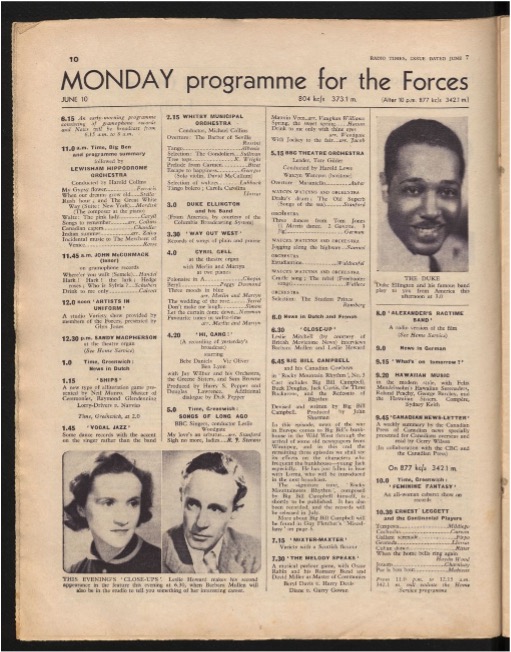
Actual page out of Radio Times (used with permission) for June 10, 1940, the first day of the Desert War.
6.15 a.m. to 8.0 a.m. Early morning program featuring gramophone records and news.
11.0 a.m. LEWISHAM HIPPODROME ORCHESTRA
11.45 a.m. JOHN McCORMICK (tenor on gramophone)
12.0 noon ARTISTS IN UNIFORM–A studio variety show provided by members of the Forces, presented by Glyn Jones
12.30 SANDY McPHERSON—Organist
1.0 Time (Greenwich) NEWS IN DUTCH
1.15 SHIPS a new alliteration game presented by Neil Munro
1.45 VOCAL JAZZ–Some dance records with the accent on the singer rather than the band
2.15 WHITBY MUNICIPAL ORCHESTRA
3.0 DUKE ELLINGTON and his Band
(From America, by courtesy of the Columbia Broadcasting System)
3.30 WAY OUT WEST–Records of songs of plain and prairie
4.0 CYRIL GELL and the theatre organ
4.20 “HIGH GANG” light comedy program
5.0 Time (Greenwich), SONGS OF LONG AGO
5.15 BBC THEATRE ORCHESTRA
6.0 NEWS IN FRENCH AND DUTCH
6.30 “CLOSE-UP” Movietone News Interviews: Lesli Howard and Barbara Mullen
6.45 BIG BILL CAMPBELL and His Canadian Cowboys
7.15 “MIXTER-MAXTER” Scottish Variety
7.30. THE MELODY SPEAKS–A musical parlour game, with Oscar Rabin and his Romany Band and David Miller as Master of Ceremonies
8.0 “ALEXANDER’S RAGTIME BAND A Radio Version of the Film
9.0 NEWS IN GERMAN
9.15 What’s On Tomorrow?
9.20 HAWAIIAN MUSIC
9.45 CANADIAN NEWS-LETTER
10.0 Time (Greenwich) FEMININE FANTASY–An all-woman cabaret show on records
10.30 ERNEST EGGETT and the Continental Players
 WWII in North Africa