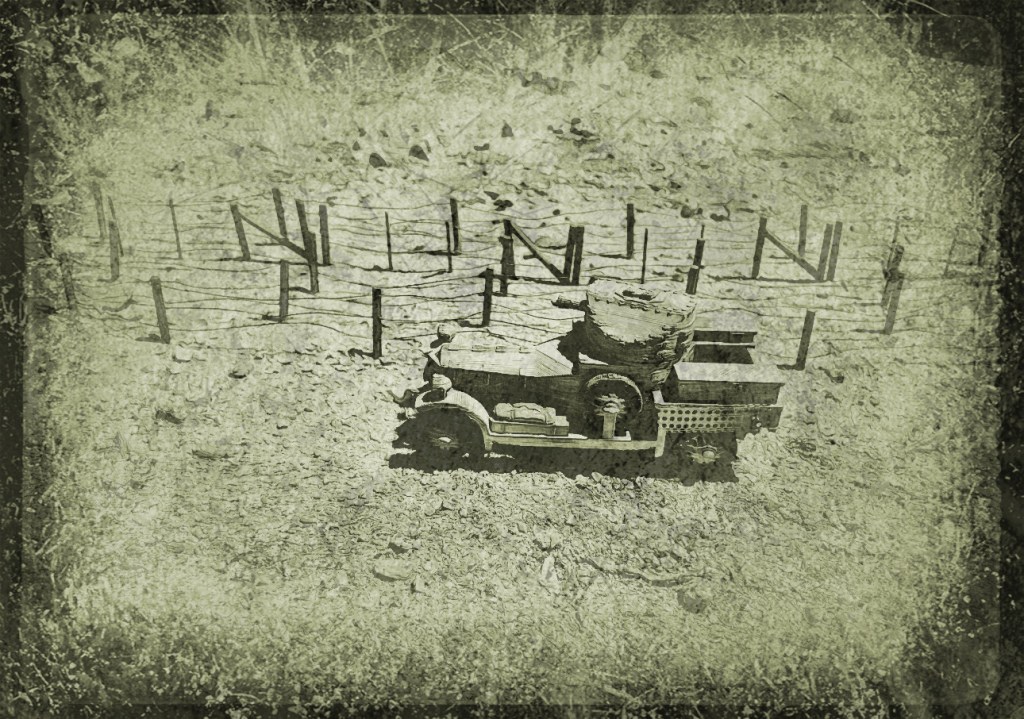
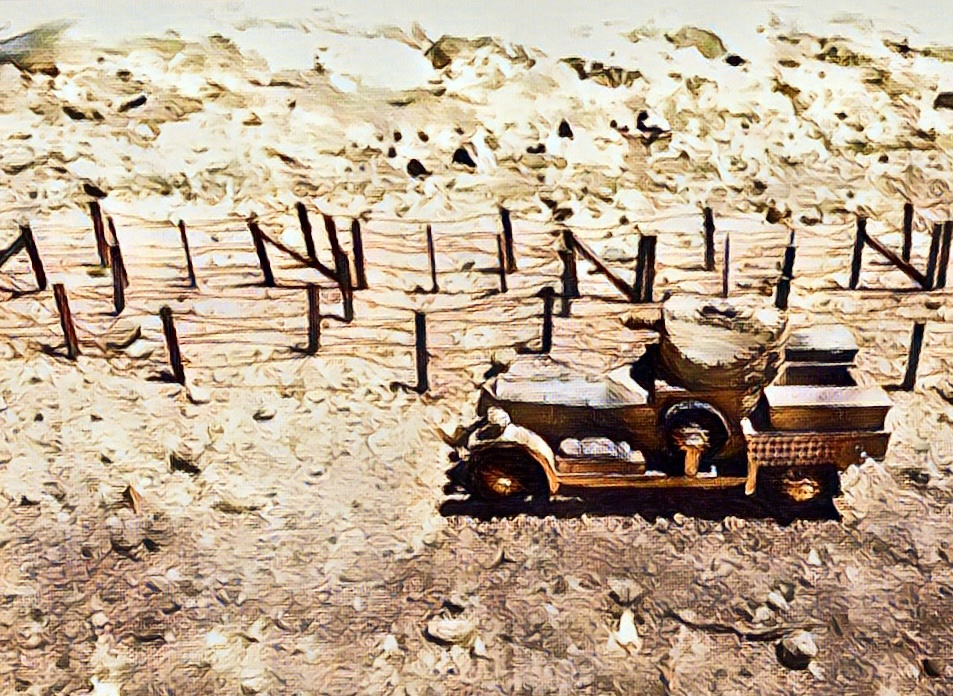
June 10, 1940–British Rolls-Royce Armored Car at the Frontier Wire
Bibliography with Notes plus Bonus Content
Bickers, Richard Townshend. The Desert Air War: a gripping historical account of the RAF’s role in North Africa during World War II. UK: Lume Books, 2018. Kindle.
Chapter One
“To mark the frontier between Libya and Egypt, the Italians built a barbed-wire fence. Twenty feet wide, with four rows of five-foot steel posts to support the strands and coils, it ran from the coast due south into the desert for 400 miles. Tanks could smash through it, but otherwise it was impenetrable without wire cutters.”
Bierman, John and Colin Smith. War Without Hate. New York: The Penguin Group, 2002, pp. 15-16.
“As soon as Mussolini declared war, the British 11th Hussars started to raid Italian roads and smaller outposts…Now they began to cross into Libya in their elderly and rather stately-looking Rolls-Royce armored cars…”
Braddock, David. Britain’s Desert War in Egypt and Libya, 1940-1942: ‘The End of the Beginning’. Yorkshire: Pen & Sword Books, 2019. Kindle.
Chapter 2: The First British Offensive
“Longmore had meanwhile concentrated all his bombers on the forward airfields so that the RAF too could attack the enemy at the first opportunity.
“These early attacks went well and Forts Capuzzo and Maddalena soon fell while armoured cars of the 11th Hussars cut the road between Tobruk and Bardia…small groups of British troops continued to attack the enemy convoys, supply dumps and outposts…As a result the Italians became increasingly reluctant to venture far from the known roads and tracks while the British, as well as demoralizing their opponents, learned how to fight in the desert.”
Cooper, Artemis. Cairo in the War 1939-1945. London: John Murray (Publishers), 2013. Kindle.
“At midnight on June 10—the moment at which Mussolini decreed that war against the Allies would begin—the 11th Hussars made the first move in the Western Desert by cutting out their way through the Wire. This was the frontier fence between Egypt and Libya, which consisted of metal posts and coiled barbed wire three lines deep and ran for hundreds of miles in a straight line across empty wastes of sand and rock. Once inside Libya, they launched a series of raids on the camps at Fort Capuzzo and Fort Maddalena that took the Italians completely by surprise. As well as destroying a number of guns, tanks and lorries, their prisoners included General Lastucci, the Engineer in Chief of 10th Army. He was captured in his staff car, with two ‘lady friends’.”
Delve, Ken. The Desert Air Force in WWII: Air Power in the Western Desert 1940-1942. South Yorkshire: Pen & Sword Books, Ltd, 2017. Kindle.
Chapter 3: From Victory to Defeat to Stalemate
“There were no navigation aids in the Western Desert or over Libya so we used a mixture of known landmarks and DR navigation (Dead Reckoning), checking course by a wrecked aircraft here, an unusual wadi there, and best of all the huge barbed wire fence and forts…”
Joly, Cyril. Take These Men: Tank Warfare with the Desert Rats. Yorkshire/Philadelphia: Pen and Sword Books, 2019. Kindle.
Part One, Chapter One: I JOURNEY TO THE DESERT
“The Italian fort at Sidi Omar was captured before the occupants even knew they were at war. The capture of Fort Capuzzo soon followed, and from then on the next six weeks patrol activity and forays of all kinds kept the Italians on the alert.”
Latimer, Jon. Operation Compass 1940: Wavell’s Whirlwind Offensive. Oxford: Osprey Publishing, 2000. Kindle.
Chapter: Origins of Campaign
“In Egypt, the declaration of war found the armoured cars of the 11th Hussars…lying close by the frontier. With instructions to raise hell, they immediately crossed the fence of barbed wire built by Italian engineers along the 440 mile (644km) border. In a series of dashing hit-and-run raids, they attacked forts and shot up transport columns, capturing bewildered soldiers whom nobody had bothered to inform about Mussolini’s declaration. By dawn 12 June, all their patrols had returned, bringing with them 70 prisoners and having suffered no casualties.”
Latimer, Jon. Operation Compass 1940: Wavell’s Whirlwind Offensive. Oxford: Osprey Publishing, 2000. Kindle.
Chapter: Opposing Armies
“The 1924-pattern Rolls-Royce operated by 11H. (Hussars). With a maximum speed of 45 mph (72 km/h) the normal armament of a Vickers machine-gun was replaced by a 14mm Boys anti-tank rifle and a Bren light machine gun. The frontier wire was breached by pushing slowly until it gave way under the pressure, a technique practiced on a specially constructed replica.”
Military History Fandom. Rolls-Royce Armoured Car. https://military-history.fandom.com/wiki/Rolls-Royce_Armoured_Car
“The vehicle was modernized in 1920 and in 1924, resulting in the Rolls-Royce 1920 Pattern and Rolls-Royce 1924 Pattern. In 1940, 34 vehicles which served in Egypt with the 11th Hussars regiment had the ‘old ’ turret replaced with an open-topped unit carrying a Boys anti-tank rifle, .303-inch Bren machine gun and smoke-grenade launchers.”
“Lawrence of Arabia used a squadron in his operations against the Turkish forces.[1] He called the unit of nine armoured Rolls-Royces ‘more valuable than rubies’ in helping win his Revolt in the Desert.[1] This impression would last with him the rest of his life; when asked by a journalist what he thought would be the thing he would most value he said ‘I should like my own Rolls-Royce car with enough tyres and petrol to last me all my life’.[1]”
“At the outbreak of World War II, 76 vehicles were in service. They were used in operations in the Western Desert, in Iraq, and in Syria.[5] By the end of 1941, they were withdrawn from the frontline service as modern armoured car designs became available.”
Moorehead, Alan. The Desert War: The Classic Trilogy on the North African Campaign 1940-1943. London: Aurum Press Ltd, 2013. Kindle.
BOOK ONE—The Mediterranean Front: The Year of Wavell 1940-41: One
“…It attacked not as a combined force, but in small units, swiftly, irregularly and by night. It pounced on Italian outposts, blew up or captured ammunition, and ran away. It stayed an hour, a day or a week, and then disappeared. The enemy had no clear idea of when he was going to be attacked next or where.”
Moorehead, Alan. The Desert War: The Classic Trilogy on the North African Campaign 1940-1943. London: Aurum Press Ltd, 2013. Kindle.
BOOK ONE—The Mediterranean Front: The Year of Wavell 1940-41: One
“Dividing Sollum and Bardia, and along the whole frontier, Mussolini had constructed a wire fence. This ran southward some hundreds of miles, and was built, it was said, to prevent Libyan natives escaping into Egypt from the Fascist regime. It consisted of a quadruple line of five-feet metal stakes bedded in concrete and closely woven with barbed wire…The escaping Libyan threw out his cloak over the barbed wire, and crawled through. The British tanks setting out on patrol into Libya simply nosed the fence aside.”
Wahlert, Glenn. The Western Desert Campaign 1940-1941 (Australian Army Campaigns Series Book 2). Sydney: Big Sky Publishing, 2011. Kindle.
Chapter: Opening Moves, Italy Invades Egypt
“…One glaring example of this was the administrative ‘oversight’ that led to the failure to inform the Italian tenth Army in Libya that it was at war. As a consequence, several border garrisons were singularly unprepared and surprised when the armoured cars of the 11 Hussar attacked that night.”
Wahlert, Glenn. The Western Desert Campaign 1940-1941 (Australian Army Campaigns Series Book 2). Sydney: Big Sky Publishing, 2011. Kindle.
Chapter: British Forces Available
“…For example, the 11th Hussars’ Rolls Royce armoured cars were World War I relics. The best British fighter available in Egypt in June 1940 was the Gloster Gladiator biplane, which was outclassed by both the Italian Machi C.200 and the Fiat G.50. Even the Italian bombers exceeded the British Blenheim bomber in both range and payload.”
Wahlert, Glenn. The Western Desert Campaign 1940-1941 (Australian Army Campaigns Series Book 2). Sydney: Big Sky Publishing, 2011. Kindle.
Chapter: British Forces Available
“From the first day of the war with Italy, the British gained the initiative by constantly harassing and attacking Italian positions at every opportunity. Within 48 hours of Italy’s declaration of war…the armoured cars of the 11th Hussars and Vickers light tanks of the 7th Hussars, captured Italian positions at Fort Capuzzo and Fort Maddelana. Many Italians did not even know they were at war.”
Bonus Illustrations
 WWII in North Africa