Western Desert Weather
Bibliography with Notes plus Bonus Content
Bickers, Richard Townshend. The Desert Air War: a gripping historical account of the RAF’s role in North Africa during World War II. UK: Lume Books, 2018. Kindle.
Chapter One
“The grit permeated their food and drink. It penetrated the entrails of the aeroplanes: a fighter that waffled sloggily through the air and flew like a brick could be found to have 80 lbs of sand aboard, mostly in the wings.”
Cooper, Artemis. Cairo in the War 1939-1945. London: John Murray (Publishers), 2013. Kindle.
Chapter: Troops
“The Italians hated the desert and kept it at bay by building stone houses in their camps, laying out paths and little gardens. The Germans fought it with science: their stores were full of foot powders, eye-lotions, insect repellents, mouth washes and disinfectants. The British, Australians and New Zealanders simply ignored the desert. They slept in blankets on the ground…”
Delve, Ken. The Desert Air Force in WWII: Air Power in the Western Desert 1940-1942. South Yorkshire: Pen & Sword Books, Ltd, 2017. Kindle.
Chapter 2: Beating the Italians in the Desert
“…[dust] had a bad effect on engines, aeroplanes, guns and bomb gear…Mechanical transport suffered to an even higher degree than aircraft engines, but the effect on personnel was as serious as that on material.”
Delve, Ken. The Desert Air Force in WWII: Air Power in the Western Desert 1940-1942. South Yorkshire: Pen & Sword Books, Ltd, 2017. Kindle.
Chapter 3: From Victory to Defeat and Stalemate
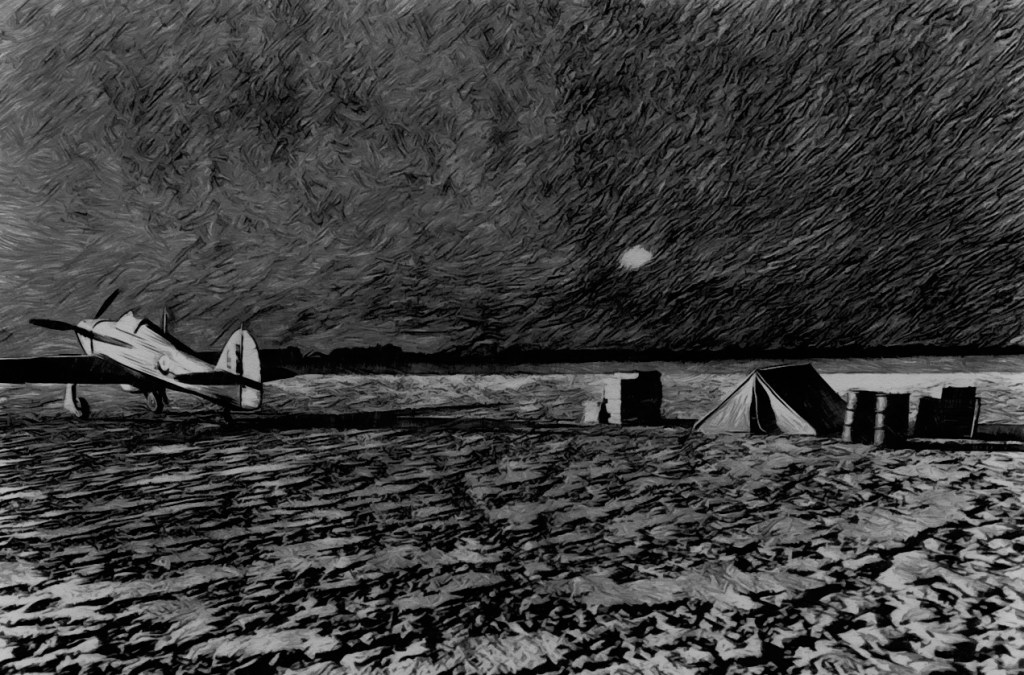
“…Fuka Satellite was typical of these desert bases, with no ‘hard’ permanent runways, no hangars or control tower—just stacks of petrol and oil cans and tents scattered all over the place amidst the barren desert landscape. The desert wind, the ‘Khamsin’ made life even worse as the sand got into everything, food drink and clothing. There were also clouds of vicious flies that descended on any exposed food…also it was prudent to check beds and clothes for scorpions and other desert nasties.”
Delve, Ken. The Desert Air Force in WWII: Air Power in the Western Desert 1940-1942. South Yorkshire: Pen & Sword Books, Ltd, 2017. Kindle.
Chapter 1: Introduction
“One of the virtues of the old P-40 was its superior insensitivity to blowing sand. But it was not immune. The crews had to spend a lot of time after one of these storms cleaning sand out of every corner and niche of the plane.”
Moorehead, Alan. The Desert War: The Classic Trilogy on the North African Campaign 1940-1943. London: Aurum Press Ltd, 2013. Kindle.
BOOK ONE—The Mediterranean Front: The Year of Wavell 1940-41: One
“In the centre of the dried-up lake stood the officers’ mess—a plain trestle-table with a camp stove burning beside it. We took tea there, and as we drank, a whistle suddenly shrilled from the edge of the camp and we ran for the slit trenches. These trenches were to become as famous as Anderson shelters in London. They were simply narrow graves dug about four feet into the earth. Whenever it stopped for the night, the first job of every fighting vehicle was to dig one of these trenches…and it was nearly a hundred percent effective. I myself have been in a trench when a bomb has burst three yards away, and come to no harm beyond being partly buried in sand.”
Moorehead, Alan. The Desert War: The Classic Trilogy on the North African Campaign 1940-1943. London: Aurum Press Ltd, 2013. Kindle.
BOOK ONE—The Mediterranean Front: The Year of Wavell 1940-41: One
“The weather was holding a steady sharp coldness, the days tempered with sunshine, the nights starry and bitter. But toward the twentieth of January a sandstorm of such violence blew up that telegraph poles were uprooted, trucks overturned, and troops huddled to the ground, wrapping their blankets over their heads.”
Moorehead, Alan. The Desert War: The Classic Trilogy on the North African Campaign 1940-1943. London: Aurum Press Ltd, 2013. Kindle.
BOOK ONE—The Mediterranean Front: The Year of Wavell 1940-41: One
“…The army for ordinary purposes accepted a pace of five or six miles an hour. The desert gave water reluctantly, and often then it was brackish (salty or briny). The army cut its man—generals and privates—down to a gallon of water a day when they were in forward positions. There was no food in the desert. The soldiers learned to exist almost entirely on tinned foods, and contrary to popular belief remained healthy on it.”
Rainier RE, Major Peter. Pipeline to Battle: An Engineer’s Adventures with the British Eighth Army. Auckland: Pickle Partners Publishing, 2013. Kindle.
PART ONE Chapter 3: The Balloon Goes Up
“…The soil of the coastal strip of the Western Desert is not true sand but a loamy clay. Churned up by the passage of vehicles, this rises in clouds at the least puff of air. When there is a gale blowing—in the Western Desert gales are frequent, and stiff breezes almost a daily occurrence—I have seen hundreds of cars halted…”
Shaw, W.B. Kennedy. Long Range Desert Group: Behind Enemy Lines in North Africa. Yorkshire: Frontline Books, 2015. Kindle.
CHAPTER THREE: FIRST SORTIES
“The worst I ever experienced…was blowing in gusts of up to 60 m.p.h., but though it whipped our skin and took the paint off the cars…”
Shores, Christopher F., and Giovanni Massimello with Russel Guest. A History of the Mediterranean Air War, 1940-1945: Volume One: North Africa. London: Grub Street, 2012. Kindle.
Chapter Introduction
“Great sandstorms would descend at any time, obliterating the landscape in a swirling fog which found its way into everything. This sand, if ingested into aero engines through the normal air intakes, could wear out the moving parts in a matter of hours, turning lubricating oil into an abrasive paste.”
Shores, Christopher F., and Giovanni Massimello with Russel Guest. A History of the Mediterranean Air War, 1940-1945: Volume One: North Africa. London: Grub Street, 2012. Kindle.
Chapter Introduction
“…To add to these hardships, the troops were plagued by millions of persistent flies which settled on faces and food continually. These conditions frequently caused ‘desert sores’ which, aggravated by heat and sand, festered on for months. Being so lacking in landmarks, the great wastes of undulating sand, rock and scrub were difficult to navigate over; to be forced down in such circumstances was to risk a lingering death from starvation and dehydration…due to extreme temperature, germs could not flourish so there was no infectious disease.”
Wahlert, Glenn. The Western Desert Campaign 1940-1941
(Australian Army Campaigns Series Book 2). Sydney: Big Sky Publishing, 2011. Kindle.
Chapter: Australia’s First Battle: Bardia
“They generally lived in holes in the ground, had to cope with freezing night temperatures, uncomfortably hot and windy days, routine shelling and air attack, horrid food and little water ‘a man could shave or wash but not both.’ The discomforts the desert posed were greater than those inflicted by the enemy.”
Wahlert, Glenn. The Western Desert Campaign 1940-1941
(Australian Army Campaigns Series Book 2). Sydney: Big Sky Publishing, 2011. Kindle.
Chapter: Tobruk Seized
“…Main supply base was 300 kilometers behind him and he was relying primarily on road transport to bring his supplies forward, often through heavy sandstorms that uprooted telegraph poles and overturned trucks.”
Bonus Illustrations
 WWII in North Africa